This blog provides information and answers questions about the world of licensed sports products in North America. Written by a licensee, Scott Sillcox, this blog contains information about sports licensing that cannot be found anywhere else on the internet. NFL, MLB, NBA, NHL, NCAA/college, MLS, NASCAR, UFC, PGA, WWE as well as the NFLPA, MLBP, NBPA, NHLPA. If you are new to sports licensing, please see my 12 part series described immediately below.
12 Part Blog Description
Are you looking to learn as much as you can about the business of sports licensing? Then please read the 12 Part "An Insider's Guide to the World of Licensed Sports Products in 12 Parts: Practical Lessons from the Trenches" - all 12 parts of the blog can be found within this site. Click here to start with the Introduction.
Thursday, March 5, 2020
I want to become a sports product licensee - How can I learn more about licensing sports products?
It's 2023 and if you have an idea for a licensed sports product but are somewhat uncertain as to what your next step should be, I'd like to help you.
People who contact me generally fall into one of two categories:
1. People who have an idea for a licensed sports product(s) and want to really learn how to obtain their own sports license – be it from the NFL, MLB, NBA, NHL, NCAA, MLS, NASCAR or other sports licensors.
and
2. People who have an idea for a sports product but would prefer to work with an existing license in some way, shape or form.
I will listen very carefully to what you have to say, and then together we can come up with the best possible path to licensing. As mentioned above, sometimes this means working with an existing licensee, in other cases it means trying to obtain your own license(s) - and there are some other alternatives as well. Together we will carefully go over the pluses and minuses of each and determine what's best for you.
I am a consultant and that's how I make my living. Let me explain the three primary ways that we could work together:
1. Telephone Consulting
I do telephone consulting at $US175/hour with a one hour minimum. If this appeals to you, all we would need to do is:
A. Schedule an hour that works for both of us
B. You would prepay the $US175 hourly fee using Paypal.
C. I ask you to consider creating a list of licensing questions that could serve as a check list near the end of our phone conversation.
D. Call me at the scheduled time
2. Meeting one-on-one in person for a full day anywhere in the US or Canada
If you have an idea for a licensed sports product and you want to obtain your own license(s) or work with an existing licensee, then a great way to move forward is for us to meet face to face for a full day (8.5 hours - $1500 fee). I'm happy to come to you almost anywhere in North America. If you sign up for a full day session ($US1500) and pay a one-time all-inclusive travel fee of $US650, I'll come right to your front door. I can send you a suggested meeting agenda - just ask - but because our one-on-one time together will be totally focused on your needs and your story, no two sessions are ever the same so the agenda is highly flexible.
During our time together we will cover a lot of ground, all of which will be focused on helping you move forward with your idea. You are welcome to bring another person or multiple people with you to the session - the more ears the better.
If you would like to move forward with spending a day together, the next steps are:
A. Let me know by email ssillcox@rogers.com or phone 416-315-4736 when and where you'd like to meet.
B. We will then schedule a session date, time and location that works for both of us.
C. You would prepay the fee using Paypal.
D. I ask you to strongly consider creating a list of licensing questions that could serve as a check list near the end of our session.
3. Working with an existing licensee
A three-part offer for people who are fairly certain they want to work with an existing licensee vs trying to obtain their own license(s)
Offer Part A.
We would speak on the phone for one hour. The phone call will have several goals, including making sure I understand as much as I can about you, your company (if any), your history and your idea. We will then discuss the three main ways of working with an existing licensee and together we will try to determine which is the best fit for you. We will also discuss how best to contact existing licensees, protecting your idea and roughly what a deal might look like. The charge for this service is normally $175/hour.
Offer Part B.
Based on our telephone conversation, I will create a prospect list with roughly 5-10 licensees for you to contact - it's hard to predict exactly how many companies I will suggest because it depends on many factors including what licenses the ideal partner would hold (NFL, MLB, NBA, NHL, NASCAR, collegiate, player associations, etc.). The document would explain why I have suggested each company and it will give you a half dozen bullet points about each company. I will also give you six months of free access to my online d-base of licensees where you can find the contact names, email addresses, phone #'s, Linkedin url's, etc. of up to six key people at each company. Creating this report generally takes me 2+ hours and I normally charge a flat fee of $350 for this service. Access to my database costs $120 for six months.
Offer Part C.
Once we jointly decide which of the three ways of working with an existing licensee would be best for you and your circumstances, I will create a template agreement between you and the licensee. This 6-10 page agreement will be written to protect you and to be fair to both you and the licensee. I will send you the document in Word format, and I urge you to then spend 2-3-4 hours reviewing it line by line, clause by clause - editing, deleting and adding as you go such that you are making the document your own. You need to be able to defend/explain every clause to your potential partner, and you can only do that if you review it carefully and understand each clause. Creating this document takes me 1.5 - 2 hours and I normally charge a flat fee of $300. Often people are interested in A and B above but are not so interested in C - in my honest opinion C is by far the most valuable service that I can provide you with and it would be a mistake not to get this document from me. One reason it's so important, and why it's important to create BEFORE you contact a single licensee, is that it prepares you for the discussion/negotiation with the licensee - it forces you to have thought through how you will work together.
The services above (A + B + C) normally cost $US950 if purchased separately, but I will bundle all of these services together and charge an all-inclusive fee of just $US575. That's a lot of bang for your buck - no-one else offers anything remotely similar to these services, let alone for only $US575.
If you have any questions or need clarification of this offer, please email me - ssillcox@rogers.com .
If you would like to move forward, the next steps are:
A. Let me know by email ssillcox@rogers.com or phone 416-315-4736 that you'd like to move forward.
B. We would schedule a time that works for both of us for our live telephone discussion.
C. You would prepay the $US575 fee using Paypal.
D. I would ask you to consider creating a list of licensing questions that could serve as a check list near the end of our phone conversation.
----------------------------------
Scott Sillcox - Biography
My name is Scott Sillcox and I owned Toronto-based Maple Leaf Productions beginning in 1997 until I sold the business in 2010. We were a licensee of the NFL, MLB, NHL and US colleges. We were licensed to produce a variety of products that were decorated with team uniforms, team logos, team names and other licensed images.
Since I sold my business, I have worked as a consultant to people interested in sports licensing. I work with 300-400 people each year. I have a good deal of licensed sports product experience that I earned firsthand as a licensee. I enjoy sharing that information with entrepreneurs and anyone else interested in entering the licensed sports product business. It is a tricky business when viewed from the outside, so take advantage of my experience. Let me give you an insider’s perspective and answer every question you have about licensed sports products.
I have written a fairly widely-read 12 part series called “An Insider's Guide to the World of Licensed Sports Products in 12 Parts: Practical Lessons from the Trenches", which can be found here.
I have also created a searchable online directory of most of the licensed sports products companies and key personnel in North America. This valuable resource can be found here.
For more information, please contact:
Scott Sillcox
Aurora, ON
Cell: 416-315-4736
Email: ssillcox@rogers.com
Youtube video on sports licensing
Scott on Linkedin
Many thanks for your time!
Scott
Monday, December 9, 2019
List of NBA Licensees as of 2020 and a bit of a look back in time
According to my stats, here are how many companies were licensees of a league between 2012 and 2020 but are no longer licensees of that same league:
2. The fact that the NBA currently has 181 licensees and yet there are 227 companies that are no longer licensees but were at one point in the last eight years also suggests to me, no perhaps screams to me, that being an NBA licensee is not for the faint of heart. You had better be darned sure that you want to enter this licensing space.
Monday, July 2, 2012
Licensing U - If you have an idea for a licensed sports product, this workshop is for you
This note is written by Scott Sillcox in fall 2023. While the blog posting below has a lot of good info, an updated version for 2023 can be found here:
I am a consultant and I work in the licensing field virtually every day of my life, so if you have questions or would like my help, contact me!
Many thanks -
Scott Sillcox
================
Greetings!
In response to a need that many of the readers of this blog have expressed, in 2012 I launched Licensing U: A one day workshop on almost everything you wanted to know about Licensed Sports Products.
I have been holding these workshops for five years, and the spring 2018 tour dates and cities are shown below. Attendance at each workshop is strictly limited to 5 participants/organizations.
As you may know, from 1997 to 2010 I was a licensee of the NFL, MLB, NHL and through an affiliated company, the NCAA/US colleges. In 2011 I wrote the 12-part blog entitled “An Insider’s Guide to the World of Licensed Sports Products: Practical Lessons from the Trenches”, and in May of 2012 I introduced the highly searchable directory of 1500+ licensed sports companies in North America - a database that I update at least weekly, often daily.. Both of these highly unique resources have proven to be invaluable guides to people and companies contemplating entering the world of licensed sports products, and together are viewed by more than 3500 people per month – quite a stunning number for such a specific field. Many thanks for your support and readership!
I speak with, and email, a great number of wonderful people each and every day about licensing and licensed sports products, and they generally fall into one of two categories:
1. People who have an idea for a licensed sports product(s) and want to really learn how to obtain their own sports license – be it from the NFL, MLB, NBA, NHL, NCAA, MLS, Nascar or other sports licensors.
and
2. People who have an idea for a sports product but would prefer to work with an existing license in some way, shape or form.
The idea for Licensing U came from these conversations – there simply seems to be a massive need for knowledge. A need for an educational, hands-on forum where people can learn even more about entering the licensed sports product world – whether it’s with a focus on acquiring their own license or working with an existing licensee – the workshop will address both needs.
Prior to entering the licensed sports product field, I ran seminars, conferences and trade shows across North America so I am very comfortable in organizing a two day workshop in a handful of key North American markets. The key is that these workshops will be very hands on - highly interactive - with a lot of back and forth dialogue between me and the participants. That’s why it is so important to me that the attendance be limited to no more than 5 people per workshop.
In fact, the participatory, sharing-of-information nature of the workshop is so important to me that I am asking each person who registers to agree to the following statement: “The sharing of ideas during the workshop is encouraged and welcomed – you will only get from this workshop what you put into it. That being said, share only what you feel comfortable with sharing, and understand that none of your fellow attendees are bound by non-disclosure agreements.”
If you would like to see an agenda for the workshop, please send an email ssillcox@rogers.com.
If you are interested in sports licensing but have a lot of questions, this day long workshop is a great source of information - and at $499, it's a terrific value. Workshops must be booked 30 days before the workshop date.
The cities and dates for the Spring 2018 tour are:
1. April 3 - 5 (Tues - Thurs): Boston
2. April 10 - 12 (Tues - Thurs): Cleveland & Columbus, OH
3. April 17 - 19 (Tues - Thurs): Washington DC
4. April 24 - 26 (Tues - Thurs): Ft. Lauderdale FL
5. May 1 - 3 (Tues - Thurs): Princeton NJ & NYC area
6. May 8 - 10 (Tues - Thurs): Atlanta
7. May 14 - 16 (Mon - Wed): Los Angeles
8. May 17 - 18 (Thurs – Fri): Seattle
9. May 22 - 24 (Tues - Thurs): Chicago
10. May 29 - 31 (Tues - Thurs): Dallas
Possible other cities: St. Louis, Charlotte NC, Las Vegas
And please remember that workshop registration is strictly limited to 5 people per workshop, so please don’t delay in registering by calling or emailing me.
For more information, please contact:
Scott Sillcox
Licensed Sports dot net
Aurora, ON
Cell: 416-315-4736
Email: ssillcox@rogers.com
Linkedin: http://www.linkedin.com/in/scottsillcox
Many thanks!
Scott
Tuesday, April 3, 2012
How online ecommerce stores / retailers / etailers selling licensed sports products can find suppliers / licensees / manufacturers who will sell to them and drop ship for them
This note is written by Scott Sillcox in fall 2023 in response to a lot of readers asking me two questions:
A. You wrote and posted many of your blog postings several years ago, is the info still relevant today? Short answer - absolutely! The basics of sports licensing change very little over the years, so I strongly suggest that if you are trying to learn about sports licensing, read away! I have also tried to update certain areas where there have been significant changes, so I feel comfortable in telling you that this information is still highly relevant.
B. You mention that you are a consultant and might be able to help me, do you still do consulting? Short answer - absolutely! I work in the licensing field virtually every day of my life, so if you have questions or would like my help, contact me! The two primary ways I work are hourly telephone consulting ($175US/hour) and face-to-face meetings where I come right to your office for a full day ($1500US/day + $650 travel expenses).
Many thanks and happy reading -
Scott Sillcox
================
I am getting asked the following question almost every day, so I thought I should post both the question and my answer in this blog posting.
Scott:
For someone who is starting out as an online ecommerce store / retailer / etailer of licensed sports products, how do I build a relationship with licensed sports products licensees who will sell to me? How do I find a list of the licensees? How do I find out which ones will do drop shipping for me? Can you tell me about distributors and if they will do drop shipping for me? Where do I go to read your blogs?
Dear current or future online ecommerce store / retailer / etailer:
1. Last question first: My blog can be found here. It is primarily directed at licensed sports products LICENSEES, ie companies which are currently licensees of one or more of the North American sports leagues (NFL, MLB, NBA, NHL, Nascar, NCAA, MLS, etc.), or companies/individuals wishing to become licensees of a sports league(s). But there are a number of postings that would apply to retailers/potential retailers like you and I encourage you to read away.
2. You may see other online ecommerce stores / retailers / etailers who seem to have drop shipping programs with various licensed sports product licensees (manufacturers) that you would to have relationships with. I think it’s very important that you understand as much as you can about a company called Kynetic which operates the online stores for the NFL, MLB, NBA, NHL, Nascar and ESPN. Please read this blog posting.
The same company, Kynetic, also owns a company called Fanatics (aka Team Fan Shop). Fanatics operates online stores for dozens and dozens of organizations and teams (see their list of partners here). This company (Kynetic + Fanatics) buys product from all sorts of licensed sports products companies (licensees), warehouses the product, and then ships the product - they do not ask the licensees to drop ship. This company (Kynetic + Fanatics) is the largest seller of licensed sports merchandise in the world (not just the largest online seller, the largest seller in total). So when you are trying to figure out who drop ships and who doesn’t, keep in mind that Kynetic/Fanatics does NOT ask the various licensees to drop ship for them – they buy the product outright and warehouse it themselves.
I mention all this because it is entirely possible that a website you admire and think has a drop shipping program established with a licensee (manufacturer) might in fact be a Kynetic/Fanatic website, in which case they don’t actually have a drop shipping program in place with the manufacturer.
3. If you are trying to find licensed sports product licensees (manufacturers) who will drop ship for you, here is my advice:
A. Decide what you are going to specialize in, ie NFL apparel.
B. Go to my searchable online directory and use the Advanced Search feature to find all the companies listed which sell the products you are most interested in. In this case you would search for companies which have the following characteristics: 1. Softgoods - Apparel/Jerseys/Outerwear/Tshirts and are licensed by the NFL - you should find approximately 26 companies. This is a paid directory, and costs $59 for three months use. If you're not sure if this database would be worth the investment, check out this 3 minute video that gives you a sense of what to expect.
C. Figure out which of the 26 sells product that you like (each company's website is right there on my website).
D. Pick up the phone and call each company's sales department - the phone # is right in the database as well. Ask if they have a drop shipping program for ecommerce retailers. If they do, great. If they don't, ask if they can suggest to you a DISTRIBUTOR of theirs who you can work with. To be clear, a Distributor is a company that buys product from a variety of manufacturers (licensees), stores the product in their warehouse, and then sells the product to retailers. Yes it costs you more than if you were able to buy the product from the manufacturer (licensee) directly, but not outrageously more. And most distributors have drop ship programs for online retailers like you. My online directory www.licensedsports.net also has a list of 19 distributors of licensed sports products in the USA and 9 in Canada (use Advanced search and search for 4. Licensed Sports Products Distributors and Country = USA). You can visit each of their sites to see if they carry NFL apparel, then go ahead and contact them to find out if they will drop ship for you.
For more on Distributors, please read this blog posting, especially the last portion.
4. You asked how to build a relationship with these companies (licensees and/or distributors)? By picking up the phone and calling them, and by treating them with respect and paying your bills on time (at least initially you will have to pay for everything by Credit Card, so paying on time isn't really a way to differentiate yourself since all bills will be paid immediately). If/when you become a decent sized customer, they will take note and start to do extra things for you, and one day you will wake up and find that you have built a relationship with them.
I hope this helps!
As always, if you have any questions, please contact me.
Scott
PS from Feb 2013
I hear from a lot of retailers, both bricks and mortar and e-commerce retailers, who want to buy jerseys to sell from their store but seemingly can't buy jerseys. Here's the best way I can explain things:
There are actually two distinct issues:
1. Identifying which officially licensed companies make replica or authentic jerseys.
2. Figuring out if any of them will sell the jerseys directly to you.
To explain, let's use the NFL and their jerseys as the example:
A. Nike is the official on-field jersey licensee for the NFL (I am using layman's terms), but they may only sell to a certain, select type of bricks and mortar retailer and to a select type of e-commerce retailer. I am not privy to their criteria for who they will and will not sell to - you have to work the phone with Nike's sales team and find out if they will sell to you or not. If they will not sell to you directly, you need to ask them if one or more of the entities they sell to (I would refer to these entities as a distributor, but Nike might call them something quite different) would in turn be willing to sell to you. And that's the key for you - you need to figure out who you can buy from - I do not have this info but Nike does. If anyone can share with me the names of a "distributor" who will sell Nike jerseys to independent bricks and mortar retailers and independent e-comm retailers, please let me know - there is a flood of companies wanting to buy from you. Also, please keep in mind that Nike sells several different "grades" of jerseys: they sell a Game Jersey which looks more or less like the on-field jersey and retails for $100-ish; a Limited Jersey which is a funky jersey not worn onfield and retails for $135-ish; and an Elite Jersey which appears to be the actual onfield style jersey and which retails for $250-ish).
B. In addition to Nike, Mitchell & Ness (owned by adidas/Reebok), also has an NFL jersey license, albeit for Throwback Jerseys ($250-ish retail) and Replica Jerseys (these appear to be throwbacks but are a different quality than the Throwback jersey line - these Replica jerseys retail for $140-ish). So you might also want to speak to M&N and see if you can buy directly from them or if not direct, could you buy through a "distributor"?
Wednesday, March 21, 2012
Ode to a wastebasket: The J. Chein Company and a 40 year old licensed sports product
At the bottom of this blog I have added some text that isn’t overly readable, so please feel free to bypass it. I have written and included it largely as a way to use the powers of the internet to try to find anyone out there who might have in their possession a list of early NFL, MLB, NBA or NHL licensees. The reason I am trying to find these lists is to do a study on the longevity of licensees – also a pet project.
I have previously touched on the subject of early licenses and longevity:
A. Sports Specialties Corporation and David Warsaw, generally considered the grandfather of the licensed sports industry
B. The turnover of NFL licenses from 2003 to 2012
C. And to this small body of work I am adding, through this blog, the story of The J. Chein Company, aka Cheinco (pronounced “Chain-co”), another pioneer in the business of licensed products in general and licensed sports products in particular.
So without further ado, here is the story of The J. Chein Company – Cheinco – an early licensed sports products company.
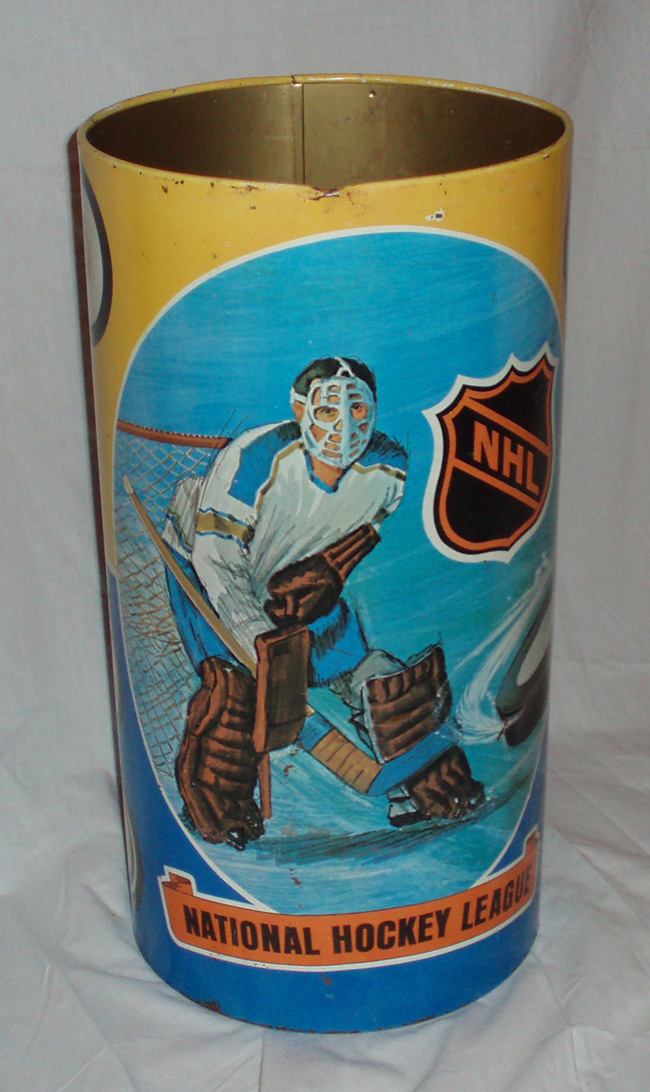
I have owned the wastebasket pictured below since I was 13 years old in 1971. It’s a classic, says “National Hockey League Services 1971” along the seam, and has “Cheinco Housewares – J. Chein & Co. Burlington, NJ 08016” stamped on the bottom.
The J. Chein Company intrigues me for two reasons:
1. As mentioned, I have owned this wastebasket since 1971. I think this is a great product – it is well made (still going strong and doing yeoman work on a daily basis for 40 years and counting); it uses all the then-current teams’ logos and thus was a brilliant early example of a licensed product that overcame the “regionalism” that limits sales of licensed products and thus could be sold in any hockey market (modern licensees take note!!!); and I think it’s quite attractive in a licensed-sports-products sort of way. Just great work on Cheinco’s part.
2. As Alan Jaffe, author of “J. Chein & Co, American Toymaker”, wrote in 1995: “The Chein company pioneered the process of product licensing in the 1920’s and 1930’s, purchasing the art and rights for comic character toys featuring Popeye [Popeye the cartoon debuted in 1929], Felix (Felix debuted as a silent movie in 1919 and as a comic strip in 1923], then later the Disney characters, and eventually the Ninja Turtles and company advertising logos, such as Coca Cola.” How about that – Cheinco was purchasing the art and rights - licensing – in the 1920’s!
Here, in Mr. Jaffe’s words, is a summary of the story of The J. Chein Company. Content for this article is from the June 1995 issues of a magazine called “Inside Collector”, and is written by Alan Jaffe, author of a book called “J. Chein & Co, American Toymaker”.
The J. Chein Company
The company began in a loft in New York City in 1903, with a metal-stamping operation run by Julius Chein. The company produced small tin prizes for the Cracker Jack boxes and other small toys for five and dime stores. Although the Chein Company made the advertising tins that we collect in its later years, its reputation is built on the nostalgic tin toys and tin banks that are so collectible.
Robert Beckleman, the last president of Chein Industries Inc., says that Julius Chein had a friend with the American Can Company who convinced the toy maker to lithograph designs on metal instead of painting them. American Can did the litho work for them until 1907, when Chein opened a plant in Harrison, New Jersey. They manufactured lithographed noisemakers, horse-drawn carts and coin banks which were sold mainly through the Woolworth chain stores.
Julius Chein was killed in a riding accident in 1926. He fell or was knocked from his horse, in Central Park, although there are variations on the story of his death. He was known for his violent temper, and was known to fly into a rage over something that went wrong at the plant. Stories tell that he had even been known to take off his watch, throw it on the floor, and jump on it when he was angry.
Back to the story of his death, it is rumored that he died of an apoplectic fit when his horse refused to jump. All that is documented, of course, is that he was riding his horse when he was killed. Chein had a disability that may have attributed to his bad temperament. He lost one of his arms as a child in a fireworks explosion. He had been fooling around with fireworks, which went off and blew off his arm (or part of it).
Mrs. Chein inherited the toy making company after her husband's death and turned the reins over to her brother, Samuel Hoffman. Mr. Hoffman had worked for Chein earlier when he was younger, but had left the Chein Company to start his own competing toy company, Mohawk Toys. The Chein Company flourished for decades under his direction, producing some of its most popular toys. Mr. Hoffman was a significant step in building the company in the early years.
In the early 1940's, the metal working company retooled to come to the aid of the war effort. Instead of toys, Chein made munitions: nosecones and tails for bombs, and the casing for incendiary devices. Times following World War II were prosperous years, but that time also marked the introduction of foreign made toys. The Japanese were exporting the small mechanical toys inexpensively, which had a tremendous impact on the Chein Company. Chein countered this by making larger mechanical toys that would be bulky and very costly for the Japanese to send to the United States. This time period led the Chein Company to produce some of the most collectible of any of the toys it ever manufactured. The Ferris wheel, which Chein had been producing since the 1930's, was refined, the company's first roller coaster was manufactured in 1949, the Playland Merry-Go-Round in 1950, the Space Ride and larger Rocket Ride came along in the early 1950's.
In 1949, the Chein Company left its 50,000 square foot facility in Harrison and built a new shop in Burlington, New Jersey - a more economical one floor plant of 75,000 square ft. Most of the front-line supervision, most of the toy and dye-makers, lithographers, and the very key manufacturing personnel made the move to Burlington. In peak seasons, Chein employed 600 people at the new factory.
Two problems contributed to later difficulties for the Chein Company. In addition to the onset of small foreign toys, giving the company its first real competition, the company still had strong ties with Woolworth, and nurtured their relationship. At this time Woolworth was the number one variety store and controlled some of the distribution of toys. It was inconceivable for them to consider a separation from Woolworth, so all Chein toys were still being sold only through this one outlet. The other problem was that plastic was available as a cheaper material to make toys, but Mr. Hoffman, still in control of the Chein Company, refused to turn to plastics. He didn't believe in the viability of plastic as a material, a shortcoming that greatly contributed to the demise of the company.
The Chein company pioneered the process of product licensing in the 1920s and 1930s, purchasing the art and rights for comic character toys featuring Popeye, Felix, then later the Disney characters, and eventually the Ninja Turtles and company advertising logos, such as Coca Cola.
Still, the company was working with a material that was rapidly becoming obsolete. Plastic was quickly taking over metal fabrication in both the toy and housewares divisions. Steel was too expensive, plastic was the new base material and the wave of the future. Rejecting plastics, refusing to involve their products in television advertising, and not selling to the mass merchandisers and discount stores, the company could not survive much longer. They did try to move into plastics, but it never quite worked for them.
Then in the mid-60s, Samuel Hoffman retired from Chein. Shortly afterwards the U.S. government hurried the end of the production of tin toys because of the hazards of their sharp edges. The cost of retooling to curl the edges of the toys was cost prohibitive, and thus ended the Chein era of tin toys.
The Chein toy division expanded its marketing and development, acquiring the Learning Aids Group, including its Renwal Plastic Division. Although they made toy planes, boats and cars, what most of us remember most from this company is the Visible Man and the Visible Woman.
In downsizing efforts a few years later, Renwal was sold and the toy division of Chein was discontinued. The company turned all of its attention to housewares in 1976, which they had been producing since the mid-fifties. Their products included kitchen canisters, bread boxes and one of their most successful items -- wastebaskets. It is in this time period that their advertising tins started being manufactured. Many of the Cheinco tins were given away empty when the products were purchased, sitting next to the actual products or on special displays in the grocery stores. There were also sets of tins, e.g. Sunkist California Dream Tin, Heinz Pearl Onions, and Maxwell House Coffee that were sold in department stores, packaged as a cannister set.
In the 1980's Cheinco Industries, produced a series of lithographed steel "carry-all" tins including Donald Duck, Star Wars and Oreos. Throwbacks to the two-handled pails of the 1920's and 1930's, these tins ins were too small to carry an entire lunch, but nonetheless turned up in lunch box collections. It was also around this time, that Bristol Ware, a division of Cheinco, reproduced the very popular roly poly Tobacco Tins. (Note: not sure when the Bristol Ware Division started, came into being or how production was broken down).
The company continued with the housewares until the late 1980's, when the company was sold to the Atlantic Can Company and was then known as the Atlantic Cheinco Corp. The Atlantic Can Company produced cake and cookie tins, but was beset by problems including chemical odors being released from the plant and the fact that they were, according to bankruptcy proceedings "a seasonal company trying to go counter-seasonal". The company, one of the world's leaving manufacturers of metal lithographed containers, including cookie tins, kitchen canisters, and wastebaskets filed for bankruptcy in February 1992, two years after one of their biggest successes, 700,000 Ninja Turtle wastebaskets were sold! Later that year Ellisco Inc., a Pennsylvania company, purchased the assets of Cheinco.
Many thanks for reading!
Scott
PS Here is what our friends at Wikipedia have to say about "J. Chein & Company”.
--------------------------------------------------
I am trying to find a list of NFL licensees from the 1960’s or 1970’s or 1980’s; a list of MLB licensees from the 1960’s or 1970’s or 1980’s; a list of NBA licensees from the 1960’s or 1970’s or 1980’s; and a list of NHL licensees from the 1960’s or 1970’s or 1980’s.
More specifically, I was wondering if anyone out there (perhaps a former licensee or a former employee of one of the leagues’ licensing departments?) has a list of any of the following:
Lists from the 1960’s:
1. A list of NFL licensees from 1960 (or thereabouts).
It is possible that there wasn’t any formal licensing until 1963 when a company known as Sports Specialties Corporation became the first official licensee of the newly founded "National Football League Properties". See Blog Part 12 for more on Sports Specialties Corp. and its founder David Warsaw. http://licensedsports.blogspot.ca/2012/03/insiders-guide-to-world-of-licensed_6196.html
2. A list of MLB licensees from 1960 (or thereabouts).
The previously mentioned Sports Specialties Corp started selling licensed MLB bobblehead dolls in 1960 si it’s possible a “list” of licensees might exist from the early 1960’s. MLB Properties, which is still in existence today, was formed in 1966, but there may have been a predecessor organization known by a different name.
3. A list of NBA licensees from 1960 (or thereabouts).
It may be that there was no formal licensing of NBA product in the early 1960’s, or it may have started later on in the decade. NBA Properties Inc. was founded in 1967 but it is possible that it operated under a different name/structure in the early-mid 1960’s.”
4. A list of NHL licensees from 1960 (or thereabouts).
We know from a famous licensed products lawsuit (Boston Professional Hockey Club vs Dallas Cap & Emblem) http://bulk.resource.org/courts.gov/c/F2/597/597.F2d.71.77-1280.html that the NHL’s licensing body officially known as “National Hockey League Services Inc.”, aka NHLS, was in operation at least by 1968. But we don’t know when NHLS began operations – an educated guess would be some time after MLB began their operation in 1960 and prior to the 1968 date mentioned in the lawsuit.
Lists from the 1970’s:
1. A list of NFL licensees from 1970 (or thereabouts).
In the 1970’s the licensing body was, and still is, “NFL Properties”.
2. A list of MLB licensees from 1970 (or thereabouts).
MLB Properties, which is still in existence today, was formed in 1966, and thus operated throughout the 1970’s.
3. A list of NBA licensees from 1970 (or thereabouts).
NBA Properties, which is still in existence today, was formed in 1967, and thus operated throughout the 1970’s.
4. A list of NHL licensees from 1970 (or thereabouts).
As mentioned above, I know for certain that in 1970 the licensing body was officially known as “National Hockey League Services Inc.”, aka NHLS. I have read, and written (in Blog Part 12), that NHL Enterprises began in 1969, but this is clearly not the case for two reasons: It was known as National Hockey League Services (NHLS) at least until at least 1971 (I have an NHL wastebasket that says National Hockey League Services 1971” on it), and perhaps much later. And secondly, we know that NHLS existed in 1968, so the 1969 date doesn’t make sense. I wondered if in saying that NHLE began in 1969, the writer was referring to NHLE or its predecessor, but that doesn’t even make sense given tat NHLS was in existence in 1968. I am certain that the NHL licensing body was known as NHL Enterprises Inc. from at least 1981 – so the gray area at the moment is from 1972 to 1980. In 1996 the name was changed to NHL Enterprises, L.P.
Lists from the 1980’s:
1. A list of NFL licensees from 1980 (or thereabouts).
The licensing body was, and still is, NFL Properties.
2. A list of MLB licensees from 1980 (or thereabouts).
The licensing body was, and still is, MLB Properties.
3. A list of NBA licensees from 1980 (or thereabouts).
The licensing body was, and still is, NBA Properties.
4. A list of NHL licensees from 1980 (or thereabouts).
I am certain that the NHL licensing body was known as NHL Enterprises Inc. from at least 1981. In 1996 the name was changed to NHL Enterprises, L.P.
Thanks for any list-finding help - I'd really appreciate it!