At the bottom of this blog I have added some text that isn’t overly readable, so please feel free to bypass it. I have written and included it largely as a way to use the powers of the internet to try to find anyone out there who might have in their possession a list of early NFL, MLB, NBA or NHL licensees. The reason I am trying to find these lists is to do a study on the longevity of licensees – also a pet project.
I have previously touched on the subject of early licenses and longevity:
A. Sports Specialties Corporation and David Warsaw, generally considered the grandfather of the licensed sports industry
B. The turnover of NFL licenses from 2003 to 2012
C. And to this small body of work I am adding, through this blog, the story of The J. Chein Company, aka Cheinco (pronounced “Chain-co”), another pioneer in the business of licensed products in general and licensed sports products in particular.
So without further ado, here is the story of The J. Chein Company – Cheinco – an early licensed sports products company.
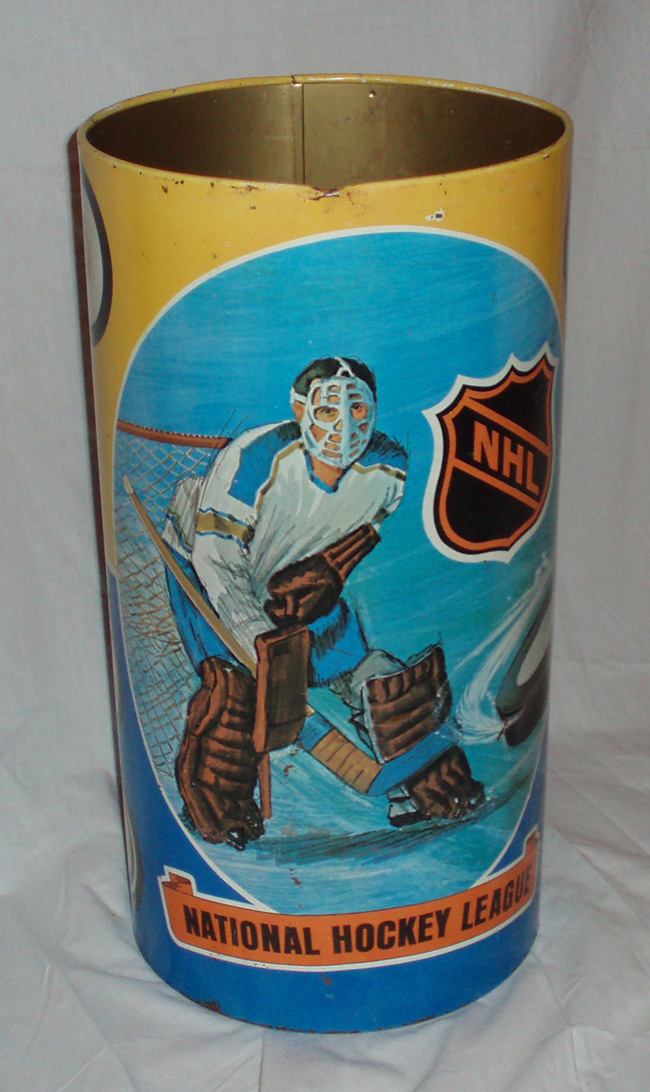
I have owned the wastebasket pictured below since I was 13 years old in 1971. It’s a classic, says “National Hockey League Services 1971” along the seam, and has “Cheinco Housewares – J. Chein & Co. Burlington, NJ 08016” stamped on the bottom.


The J. Chein Company intrigues me for two reasons:
1. As mentioned, I have owned this wastebasket since 1971. I think this is a great product – it is well made (still going strong and doing yeoman work on a daily basis for 40 years and counting); it uses all the then-current teams’ logos and thus was a brilliant early example of a licensed product that overcame the “regionalism” that limits sales of licensed products and thus could be sold in any hockey market (modern licensees take note!!!); and I think it’s quite attractive in a licensed-sports-products sort of way. Just great work on Cheinco’s part.
2. As Alan Jaffe, author of “J. Chein & Co, American Toymaker”, wrote in 1995: “The Chein company pioneered the process of product licensing in the 1920’s and 1930’s, purchasing the art and rights for comic character toys featuring Popeye [Popeye the cartoon debuted in 1929], Felix (Felix debuted as a silent movie in 1919 and as a comic strip in 1923], then later the Disney characters, and eventually the Ninja Turtles and company advertising logos, such as Coca Cola.” How about that – Cheinco was purchasing the art and rights - licensing – in the 1920’s!
Here, in Mr. Jaffe’s words, is a summary of the story of The J. Chein Company. Content for this article is from the June 1995 issues of a magazine called “Inside Collector”, and is written by Alan Jaffe, author of a book called “J. Chein & Co, American Toymaker”.

The J. Chein Company
The company began in a loft in New York City in 1903, with a metal-stamping operation run by Julius Chein. The company produced small tin prizes for the Cracker Jack boxes and other small toys for five and dime stores. Although the Chein Company made the advertising tins that we collect in its later years, its reputation is built on the nostalgic tin toys and tin banks that are so collectible.
Robert Beckleman, the last president of Chein Industries Inc., says that Julius Chein had a friend with the American Can Company who convinced the toy maker to lithograph designs on metal instead of painting them. American Can did the litho work for them until 1907, when Chein opened a plant in Harrison, New Jersey. They manufactured lithographed noisemakers, horse-drawn carts and coin banks which were sold mainly through the Woolworth chain stores.
Julius Chein was killed in a riding accident in 1926. He fell or was knocked from his horse, in Central Park, although there are variations on the story of his death. He was known for his violent temper, and was known to fly into a rage over something that went wrong at the plant. Stories tell that he had even been known to take off his watch, throw it on the floor, and jump on it when he was angry.
Back to the story of his death, it is rumored that he died of an apoplectic fit when his horse refused to jump. All that is documented, of course, is that he was riding his horse when he was killed. Chein had a disability that may have attributed to his bad temperament. He lost one of his arms as a child in a fireworks explosion. He had been fooling around with fireworks, which went off and blew off his arm (or part of it).
Mrs. Chein inherited the toy making company after her husband's death and turned the reins over to her brother, Samuel Hoffman. Mr. Hoffman had worked for Chein earlier when he was younger, but had left the Chein Company to start his own competing toy company, Mohawk Toys. The Chein Company flourished for decades under his direction, producing some of its most popular toys. Mr. Hoffman was a significant step in building the company in the early years.
In the early 1940's, the metal working company retooled to come to the aid of the war effort. Instead of toys, Chein made munitions: nosecones and tails for bombs, and the casing for incendiary devices. Times following World War II were prosperous years, but that time also marked the introduction of foreign made toys. The Japanese were exporting the small mechanical toys inexpensively, which had a tremendous impact on the Chein Company. Chein countered this by making larger mechanical toys that would be bulky and very costly for the Japanese to send to the United States. This time period led the Chein Company to produce some of the most collectible of any of the toys it ever manufactured. The Ferris wheel, which Chein had been producing since the 1930's, was refined, the company's first roller coaster was manufactured in 1949, the Playland Merry-Go-Round in 1950, the Space Ride and larger Rocket Ride came along in the early 1950's.
In 1949, the Chein Company left its 50,000 square foot facility in Harrison and built a new shop in Burlington, New Jersey - a more economical one floor plant of 75,000 square ft. Most of the front-line supervision, most of the toy and dye-makers, lithographers, and the very key manufacturing personnel made the move to Burlington. In peak seasons, Chein employed 600 people at the new factory.
Two problems contributed to later difficulties for the Chein Company. In addition to the onset of small foreign toys, giving the company its first real competition, the company still had strong ties with Woolworth, and nurtured their relationship. At this time Woolworth was the number one variety store and controlled some of the distribution of toys. It was inconceivable for them to consider a separation from Woolworth, so all Chein toys were still being sold only through this one outlet. The other problem was that plastic was available as a cheaper material to make toys, but Mr. Hoffman, still in control of the Chein Company, refused to turn to plastics. He didn't believe in the viability of plastic as a material, a shortcoming that greatly contributed to the demise of the company.
The Chein company pioneered the process of product licensing in the 1920s and 1930s, purchasing the art and rights for comic character toys featuring Popeye, Felix, then later the Disney characters, and eventually the Ninja Turtles and company advertising logos, such as Coca Cola.
Still, the company was working with a material that was rapidly becoming obsolete. Plastic was quickly taking over metal fabrication in both the toy and housewares divisions. Steel was too expensive, plastic was the new base material and the wave of the future. Rejecting plastics, refusing to involve their products in television advertising, and not selling to the mass merchandisers and discount stores, the company could not survive much longer. They did try to move into plastics, but it never quite worked for them.
Then in the mid-60s, Samuel Hoffman retired from Chein. Shortly afterwards the U.S. government hurried the end of the production of tin toys because of the hazards of their sharp edges. The cost of retooling to curl the edges of the toys was cost prohibitive, and thus ended the Chein era of tin toys.
The Chein toy division expanded its marketing and development, acquiring the Learning Aids Group, including its Renwal Plastic Division. Although they made toy planes, boats and cars, what most of us remember most from this company is the Visible Man and the Visible Woman.
In downsizing efforts a few years later, Renwal was sold and the toy division of Chein was discontinued. The company turned all of its attention to housewares in 1976, which they had been producing since the mid-fifties. Their products included kitchen canisters, bread boxes and one of their most successful items -- wastebaskets. It is in this time period that their advertising tins started being manufactured. Many of the Cheinco tins were given away empty when the products were purchased, sitting next to the actual products or on special displays in the grocery stores. There were also sets of tins, e.g. Sunkist California Dream Tin, Heinz Pearl Onions, and Maxwell House Coffee that were sold in department stores, packaged as a cannister set.
In the 1980's Cheinco Industries, produced a series of lithographed steel "carry-all" tins including Donald Duck, Star Wars and Oreos. Throwbacks to the two-handled pails of the 1920's and 1930's, these tins ins were too small to carry an entire lunch, but nonetheless turned up in lunch box collections. It was also around this time, that Bristol Ware, a division of Cheinco, reproduced the very popular roly poly Tobacco Tins. (Note: not sure when the Bristol Ware Division started, came into being or how production was broken down).
The company continued with the housewares until the late 1980's, when the company was sold to the Atlantic Can Company and was then known as the Atlantic Cheinco Corp. The Atlantic Can Company produced cake and cookie tins, but was beset by problems including chemical odors being released from the plant and the fact that they were, according to bankruptcy proceedings "a seasonal company trying to go counter-seasonal". The company, one of the world's leaving manufacturers of metal lithographed containers, including cookie tins, kitchen canisters, and wastebaskets filed for bankruptcy in February 1992, two years after one of their biggest successes, 700,000 Ninja Turtle wastebaskets were sold! Later that year Ellisco Inc., a Pennsylvania company, purchased the assets of Cheinco.
Many thanks for reading!
Scott
PS Here is what our friends at Wikipedia have to say about "J. Chein & Company”.
--------------------------------------------------
I am trying to find a list of NFL licensees from the 1960’s or 1970’s or 1980’s; a list of MLB licensees from the 1960’s or 1970’s or 1980’s; a list of NBA licensees from the 1960’s or 1970’s or 1980’s; and a list of NHL licensees from the 1960’s or 1970’s or 1980’s.
More specifically, I was wondering if anyone out there (perhaps a former licensee or a former employee of one of the leagues’ licensing departments?) has a list of any of the following:
Lists from the 1960’s:
1. A list of NFL licensees from 1960 (or thereabouts).
It is possible that there wasn’t any formal licensing until 1963 when a company known as Sports Specialties Corporation became the first official licensee of the newly founded "National Football League Properties". See Blog Part 12 for more on Sports Specialties Corp. and its founder David Warsaw. http://licensedsports.blogspot.ca/2012/03/insiders-guide-to-world-of-licensed_6196.html
2. A list of MLB licensees from 1960 (or thereabouts).
The previously mentioned Sports Specialties Corp started selling licensed MLB bobblehead dolls in 1960 si it’s possible a “list” of licensees might exist from the early 1960’s. MLB Properties, which is still in existence today, was formed in 1966, but there may have been a predecessor organization known by a different name.
3. A list of NBA licensees from 1960 (or thereabouts).
It may be that there was no formal licensing of NBA product in the early 1960’s, or it may have started later on in the decade. NBA Properties Inc. was founded in 1967 but it is possible that it operated under a different name/structure in the early-mid 1960’s.”
4. A list of NHL licensees from 1960 (or thereabouts).
We know from a famous licensed products lawsuit (Boston Professional Hockey Club vs Dallas Cap & Emblem) http://bulk.resource.org/courts.gov/c/F2/597/597.F2d.71.77-1280.html that the NHL’s licensing body officially known as “National Hockey League Services Inc.”, aka NHLS, was in operation at least by 1968. But we don’t know when NHLS began operations – an educated guess would be some time after MLB began their operation in 1960 and prior to the 1968 date mentioned in the lawsuit.
Lists from the 1970’s:
1. A list of NFL licensees from 1970 (or thereabouts).
In the 1970’s the licensing body was, and still is, “NFL Properties”.
2. A list of MLB licensees from 1970 (or thereabouts).
MLB Properties, which is still in existence today, was formed in 1966, and thus operated throughout the 1970’s.
3. A list of NBA licensees from 1970 (or thereabouts).
NBA Properties, which is still in existence today, was formed in 1967, and thus operated throughout the 1970’s.
4. A list of NHL licensees from 1970 (or thereabouts).
As mentioned above, I know for certain that in 1970 the licensing body was officially known as “National Hockey League Services Inc.”, aka NHLS. I have read, and written (in Blog Part 12), that NHL Enterprises began in 1969, but this is clearly not the case for two reasons: It was known as National Hockey League Services (NHLS) at least until at least 1971 (I have an NHL wastebasket that says National Hockey League Services 1971” on it), and perhaps much later. And secondly, we know that NHLS existed in 1968, so the 1969 date doesn’t make sense. I wondered if in saying that NHLE began in 1969, the writer was referring to NHLE or its predecessor, but that doesn’t even make sense given tat NHLS was in existence in 1968. I am certain that the NHL licensing body was known as NHL Enterprises Inc. from at least 1981 – so the gray area at the moment is from 1972 to 1980. In 1996 the name was changed to NHL Enterprises, L.P.
Lists from the 1980’s:
1. A list of NFL licensees from 1980 (or thereabouts).
The licensing body was, and still is, NFL Properties.
2. A list of MLB licensees from 1980 (or thereabouts).
The licensing body was, and still is, MLB Properties.
3. A list of NBA licensees from 1980 (or thereabouts).
The licensing body was, and still is, NBA Properties.
4. A list of NHL licensees from 1980 (or thereabouts).
I am certain that the NHL licensing body was known as NHL Enterprises Inc. from at least 1981. In 1996 the name was changed to NHL Enterprises, L.P.
Thanks for any list-finding help - I'd really appreciate it!

