12 Part Blog Description

Are you looking to learn as much as you can about the business of sports licensing? Then please read the 12 Part "An Insider's Guide to the World of Licensed Sports Products in 12 Parts: Practical Lessons from the Trenches" - all 12 parts of the blog can be found within this site. Click here to start with the Introduction.

Showing posts with label Licensed Sports Products. Show all posts

Thursday, March 5, 2020

I want to become a sports product licensee - How can I learn more about licensing sports products?

Greetings!

It's 2023 and if you have an idea for a licensed sports product but are somewhat uncertain as to what your next step should be, I'd like to help you.


People who contact me generally fall into one of two categories:

1. People who have an idea for a licensed sports product(s) and want to really learn how to obtain their own sports license – be it from the NFL, MLB, NBA, NHL, NCAA, MLS, NASCAR or other sports licensors.

and

2. People who have an idea for a sports product but would prefer to work with an existing license in some way, shape or form.

I will listen very carefully to what you have to say, and then together we can come up with the best possible path to licensing. As mentioned above, sometimes this means working with an existing licensee, in other cases it means trying to obtain your own license(s) - and there are some other alternatives as well. Together we will carefully go over the pluses and minuses of each and determine what's best for you.


I am a consultant and that's how I make my living. Let me explain the three primary ways that we could work together:

1. Telephone Consulting 
I do telephone consulting at $US175/hour with a one hour minimum. If this appeals to you, all we would need to do is:
A. Schedule an hour that works for both of us
B. You would prepay the $US175 hourly fee using Paypal.
C. I ask you to consider creating a list of licensing questions that could serve as a check list near the end of our phone conversation.
D. Call me at the scheduled time


2. Meeting one-on-one in person for a full day anywhere in the US or Canada
If you have an idea for a licensed sports product and you want to obtain your own license(s) or work with an existing licensee, then a great way to move forward is for us to meet face to face for a full day (8.5 hours - $1500 fee).  I'm happy to come to you almost anywhere in North America. If you sign up for a full day session ($US1500) and pay a one-time all-inclusive travel fee of $US650, I'll come right to your front door. I can send you a suggested meeting agenda - just ask - but because our one-on-one time together will be totally focused on your needs and your story, no two sessions are ever the same so the agenda is highly flexible.

During our time together we will cover a lot of ground, all of which will be focused on helping you move forward with your idea. You are welcome to bring another person or multiple people with you to the session - the more ears the better.

If you would like to move forward with spending a day together, the next steps are:
A. Let me know by email ssillcox@rogers.com or phone 416-315-4736 when and where you'd like to meet.
B. We will then schedule a session date, time and location that works for both of us.
C. You would prepay the fee using Paypal.
D. I ask you to strongly consider creating a list of licensing questions that could serve as a check list near the end of our session.


3. Working with an existing licensee
A three-part offer for people who are fairly certain they want to work with an existing licensee vs trying to obtain their own license(s)

Offer Part A.
We would speak on the phone for one hour. The phone call will have several goals, including making sure I understand as much as I can about you, your company (if any), your history and your idea. We will then discuss the three main ways of working with an existing licensee and together we will try to determine which is the best fit for you. We will also discuss how best to contact existing licensees, protecting your idea and roughly what a deal might look like. The charge for this service is normally $175/hour.

Offer Part B.
Based on our telephone conversation, I will create a prospect list with roughly 5-10 licensees for you to contact - it's hard to predict exactly how many companies I will suggest because it depends on many factors including what licenses the ideal partner would hold (NFL, MLB, NBA, NHL, NASCAR, collegiate, player associations, etc.). The document would explain why I have suggested each company and it will give you a half dozen bullet points about each company. I will also give you six months of free access to my online d-base of licensees where you can find the contact names, email addresses, phone #'s, Linkedin url's, etc. of up to six key people at each company. Creating this report generally takes me 2+ hours and I normally charge a flat fee of $350 for this service. Access to my database costs $120 for six months.

Offer Part C.
Once we jointly decide which of the three ways of working with an existing licensee would be best for you and your circumstances, I will create a template agreement between you and the licensee. This 6-10 page agreement will be written to protect you and to be fair to both you and the licensee. I will send you the document in Word format, and I urge you to then spend 2-3-4 hours reviewing it line by line, clause by clause - editing, deleting and adding as you go such that you are making the document your own. You need to be able to defend/explain every clause to your potential partner, and you can only do that if you review it carefully and understand each clause. Creating this document takes me 1.5 - 2 hours and I normally charge a flat fee of $300. Often people are interested in A and B above but are not so interested in C - in my honest opinion C is by far the most valuable service that I can provide you with and it would be a mistake not to get this document from me. One reason it's so important, and why it's important to create BEFORE you contact a single licensee, is that it prepares you for the discussion/negotiation with the licensee - it forces you to have thought through how you will work together.


The services above (A + B + C) normally cost $US950 if purchased separately, but I will bundle all of these services together and charge an all-inclusive fee of just $US575. That's a lot of bang for your buck - no-one else offers anything remotely similar to these services, let alone for only $US575.

If you have any questions or need clarification of this offer, please email me - ssillcox@rogers.com .

If you would like to move forward, the next steps are:
A. Let me know by email ssillcox@rogers.com or phone 416-315-4736 that you'd like to move forward.
B. We would schedule a time that works for both of us for our live telephone discussion.
C. You would prepay the $US575 fee using Paypal.
D. I would ask you to consider creating a list of licensing questions that could serve as a check list near the end of our phone conversation.

----------------------------------

Scott Sillcox - Biography

My name is Scott Sillcox and I owned Toronto-based Maple Leaf Productions beginning in 1997 until I sold the business in 2010. We were a licensee of the NFL, MLB, NHL and US colleges. We were licensed to produce a variety of products that were decorated with team uniforms, team logos, team names and other licensed images.

Since I sold my business, I have worked as a consultant to people interested in sports licensing. I work with 300-400 people each year. I have a good deal of licensed sports product experience that I earned firsthand as a licensee. I enjoy sharing that information with entrepreneurs and anyone else interested in entering the licensed sports product business. It is a tricky business when viewed from the outside, so take advantage of my experience. Let me give you an insider’s perspective and answer every question you have about licensed sports products.

I have written a fairly widely-read 12 part series called “An Insider's Guide to the World of Licensed Sports Products in 12 Parts: Practical Lessons from the Trenches", which can be found here.

I have also created a searchable online directory of most of the licensed sports products companies and key personnel in North America. This valuable resource can be found here.


For more information, please contact:
Scott Sillcox
Aurora, ON
Cell: 416-315-4736
Email: ssillcox@rogers.com
Youtube video on sports licensing
Scott on Linkedin

Many thanks for your time!
Scott

Monday, July 2, 2012

Licensing U - If you have an idea for a licensed sports product, this workshop is for you

Greeting folks!

This note is written by Scott Sillcox in fall 2023. While the blog posting below has a lot of good info, an updated version for 2023 can be found here:

I am a consultant and I work in the licensing field virtually every day of my life, so if you have questions or would like my help, contact me!

Many thanks -
Scott Sillcox

================

Greetings!

In response to a need that many of the readers of this blog have expressed, in 2012 I launched Licensing U: A one day workshop on almost everything you wanted to know about Licensed Sports Products.


I have been holding these workshops for five years, and the spring 2018 tour dates and cities are shown below. Attendance at each workshop is strictly limited to 5 participants/organizations.

As you may know, from 1997 to 2010 I was a licensee of the NFL, MLB, NHL and through an affiliated company, the NCAA/US colleges. In 2011 I wrote the 12-part blog entitled “An Insider’s Guide to the World of Licensed Sports Products: Practical Lessons from the Trenches”, and in May of 2012 I introduced the highly searchable directory of 1500+ licensed sports companies in North America - a database that I update at least weekly, often daily.. Both of these highly unique resources have proven to be invaluable guides to people and companies contemplating entering the world of licensed sports products, and together are viewed by more than 3500 people per month – quite a stunning number for such a specific field. Many thanks for your support and readership!

I speak with, and email, a great number of wonderful people each and every day about licensing and licensed sports products, and they generally fall into one of two categories:

1. People who have an idea for a licensed sports product(s) and want to really learn how to obtain their own sports license – be it from the NFL, MLB, NBA, NHL, NCAA, MLS, Nascar or other sports licensors.

and

2. People who have an idea for a sports product but would prefer to work with an existing license in some way, shape or form.

The idea for Licensing U came from these conversations – there simply seems to be a massive need for knowledge. A need for an educational, hands-on forum where people can learn even more about entering the licensed sports product world – whether it’s with a focus on acquiring their own license or working with an existing licensee – the workshop will address both needs.

Prior to entering the licensed sports product field, I ran seminars, conferences and trade shows across North America so I am very comfortable in organizing a two day workshop in a handful of key North American markets. The key is that these workshops will be very hands on - highly interactive - with a lot of back and forth dialogue between me and the participants. That’s why it is so important to me that the attendance be limited to no more than 5 people per workshop.

In fact, the participatory, sharing-of-information nature of the workshop is so important to me that I am asking each person who registers to agree to the following statement: “The sharing of ideas during the workshop is encouraged and welcomed – you will only get from this workshop what you put into it. That being said, share only what you feel comfortable with sharing, and understand that none of your fellow attendees are bound by non-disclosure agreements.”

If you would like to see an agenda for the workshop, please send an email ssillcox@rogers.com.

If you are interested in sports licensing but have a lot of questions, this day long workshop is a great source of information - and at $499, it's a terrific value. Workshops must be booked 30 days before the workshop date.

The cities and dates for the Spring 2018 tour are:
1. April 3 - 5 (Tues - Thurs): Boston
2. April 10 - 12 (Tues - Thurs): Cleveland & Columbus, OH
3. April 17 - 19 (Tues - Thurs): Washington DC
4. April 24 - 26 (Tues - Thurs): Ft. Lauderdale FL
5. May 1 - 3 (Tues - Thurs): Princeton NJ & NYC area
6. May 8 - 10 (Tues - Thurs): Atlanta
7. May 14 - 16 (Mon - Wed): Los Angeles
8. May 17 - 18 (Thurs – Fri): Seattle
9. May 22 - 24 (Tues - Thurs): Chicago
10. May 29 - 31 (Tues - Thurs): Dallas
Possible other cities: St. Louis, Charlotte NC, Las Vegas

As much as I like to share information and answer questions about sports product licensing, I particularly enjoy listening to what people have to say and the questions they pose. So if anyone has any questions, either about the workshop, the registration process or sports product licensing in general, I truly encourage you to contact me by phone 416-315-4736 or email ssillcox@rogers.com.

And please remember that workshop registration is strictly limited to 5 people per workshop, so please don’t delay in registering by calling or emailing me.

For more information, please contact:
Scott Sillcox
Licensed Sports dot net
Aurora, ON
Cell: 416-315-4736
Email: ssillcox@rogers.com
Linkedin: http://www.linkedin.com/in/scottsillcox

Many thanks!
Scott

Wednesday, March 21, 2012

Ode to a wastebasket: The J. Chein Company and a 40 year old licensed sports product

From time to time I would like to salute some of the early licensed sports products companies. There is a danger in getting too carried away with saluting past licensees only in the sense that it could be a never ending project (can you say black hole) and a bit too obscure for anyone to be overly interested in an endless stream of salutes. So rest assured I will pick and choose my spots as I profile a select number of the early licensed sports products companies. But I am also a big believer in history and learning from the past – a bit of the “those who neglect the past are doomed to repeat it” school of thought…

At the bottom of this blog I have added some text that isn’t overly readable, so please feel free to bypass it. I have written and included it largely as a way to use the powers of the internet to try to find anyone out there who might have in their possession a list of early NFL, MLB, NBA or NHL licensees. The reason I am trying to find these lists is to do a study on the longevity of licensees – also a pet project.

I have previously touched on the subject of early licenses and longevity:

A. Sports Specialties Corporation and David Warsaw, generally considered the grandfather of the licensed sports industry

B. The turnover of NFL licenses from 2003 to 2012

C. And to this small body of work I am adding, through this blog, the story of The J. Chein Company, aka Cheinco (pronounced “Chain-co”), another pioneer in the business of licensed products in general and licensed sports products in particular.

So without further ado, here is the story of The J. Chein Company – Cheinco – an early licensed sports products company.

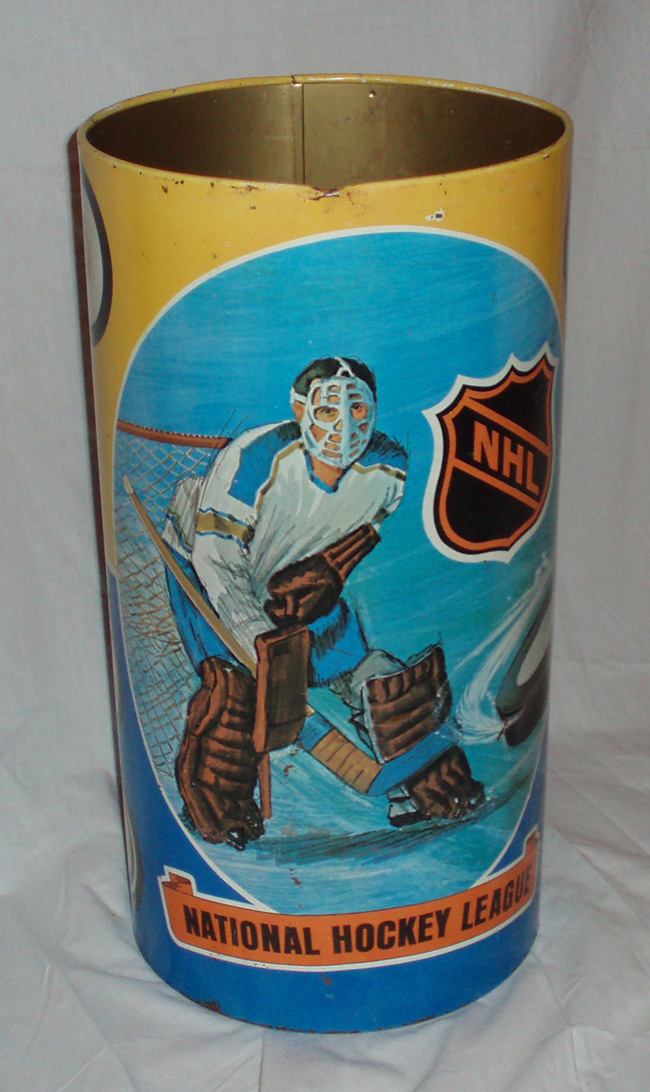
I have owned the wastebasket pictured below since I was 13 years old in 1971. It’s a classic, says “National Hockey League Services 1971” along the seam, and has “Cheinco Housewares – J. Chein & Co. Burlington, NJ 08016” stamped on the bottom.

J Chein NHL Wastebasket
NHL Services Copyright line
J Chein Company name stamp

The J. Chein Company intrigues me for two reasons:

1. As mentioned, I have owned this wastebasket since 1971. I think this is a great product – it is well made (still going strong and doing yeoman work on a daily basis for 40 years and counting); it uses all the then-current teams’ logos and thus was a brilliant early example of a licensed product that overcame the “regionalism” that limits sales of licensed products and thus could be sold in any hockey market (modern licensees take note!!!); and I think it’s quite attractive in a licensed-sports-products sort of way. Just great work on Cheinco’s part.

2. As Alan Jaffe, author of “J. Chein & Co, American Toymaker”, wrote in 1995: “The Chein company pioneered the process of product licensing in the 1920’s and 1930’s, purchasing the art and rights for comic character toys featuring Popeye [Popeye the cartoon debuted in 1929], Felix (Felix debuted as a silent movie in 1919 and as a comic strip in 1923], then later the Disney characters, and eventually the Ninja Turtles and company advertising logos, such as Coca Cola.” How about that – Cheinco was purchasing the art and rights - licensing – in the 1920’s!

Here, in Mr. Jaffe’s words, is a summary of the story of The J. Chein Company. Content for this article is from the June 1995 issues of a magazine called “Inside Collector”, and is written by Alan Jaffe, author of a book called “J. Chein & Co, American Toymaker”.

J Chein & Company book

The J. Chein Company

The company began in a loft in New York City in 1903, with a metal-stamping operation run by Julius Chein. The company produced small tin prizes for the Cracker Jack boxes and other small toys for five and dime stores. Although the Chein Company made the advertising tins that we collect in its later years, its reputation is built on the nostalgic tin toys and tin banks that are so collectible.

Robert Beckleman, the last president of Chein Industries Inc., says that Julius Chein had a friend with the American Can Company who convinced the toy maker to lithograph designs on metal instead of painting them. American Can did the litho work for them until 1907, when Chein opened a plant in Harrison, New Jersey. They manufactured lithographed noisemakers, horse-drawn carts and coin banks which were sold mainly through the Woolworth chain stores.

Julius Chein was killed in a riding accident in 1926. He fell or was knocked from his horse, in Central Park, although there are variations on the story of his death. He was known for his violent temper, and was known to fly into a rage over something that went wrong at the plant. Stories tell that he had even been known to take off his watch, throw it on the floor, and jump on it when he was angry.

Back to the story of his death, it is rumored that he died of an apoplectic fit when his horse refused to jump. All that is documented, of course, is that he was riding his horse when he was killed. Chein had a disability that may have attributed to his bad temperament. He lost one of his arms as a child in a fireworks explosion. He had been fooling around with fireworks, which went off and blew off his arm (or part of it).

Mrs. Chein inherited the toy making company after her husband's death and turned the reins over to her brother, Samuel Hoffman. Mr. Hoffman had worked for Chein earlier when he was younger, but had left the Chein Company to start his own competing toy company, Mohawk Toys. The Chein Company flourished for decades under his direction, producing some of its most popular toys. Mr. Hoffman was a significant step in building the company in the early years.

In the early 1940's, the metal working company retooled to come to the aid of the war effort. Instead of toys, Chein made munitions: nosecones and tails for bombs, and the casing for incendiary devices. Times following World War II were prosperous years, but that time also marked the introduction of foreign made toys. The Japanese were exporting the small mechanical toys inexpensively, which had a tremendous impact on the Chein Company. Chein countered this by making larger mechanical toys that would be bulky and very costly for the Japanese to send to the United States. This time period led the Chein Company to produce some of the most collectible of any of the toys it ever manufactured. The Ferris wheel, which Chein had been producing since the 1930's, was refined, the company's first roller coaster was manufactured in 1949, the Playland Merry-Go-Round in 1950, the Space Ride and larger Rocket Ride came along in the early 1950's.

In 1949, the Chein Company left its 50,000 square foot facility in Harrison and built a new shop in Burlington, New Jersey - a more economical one floor plant of 75,000 square ft. Most of the front-line supervision, most of the toy and dye-makers, lithographers, and the very key manufacturing personnel made the move to Burlington. In peak seasons, Chein employed 600 people at the new factory.

Two problems contributed to later difficulties for the Chein Company. In addition to the onset of small foreign toys, giving the company its first real competition, the company still had strong ties with Woolworth, and nurtured their relationship. At this time Woolworth was the number one variety store and controlled some of the distribution of toys. It was inconceivable for them to consider a separation from Woolworth, so all Chein toys were still being sold only through this one outlet. The other problem was that plastic was available as a cheaper material to make toys, but Mr. Hoffman, still in control of the Chein Company, refused to turn to plastics. He didn't believe in the viability of plastic as a material, a shortcoming that greatly contributed to the demise of the company.

The Chein company pioneered the process of product licensing in the 1920s and 1930s, purchasing the art and rights for comic character toys featuring Popeye, Felix, then later the Disney characters, and eventually the Ninja Turtles and company advertising logos, such as Coca Cola.

Still, the company was working with a material that was rapidly becoming obsolete. Plastic was quickly taking over metal fabrication in both the toy and housewares divisions. Steel was too expensive, plastic was the new base material and the wave of the future. Rejecting plastics, refusing to involve their products in television advertising, and not selling to the mass merchandisers and discount stores, the company could not survive much longer. They did try to move into plastics, but it never quite worked for them.

Then in the mid-60s, Samuel Hoffman retired from Chein. Shortly afterwards the U.S. government hurried the end of the production of tin toys because of the hazards of their sharp edges. The cost of retooling to curl the edges of the toys was cost prohibitive, and thus ended the Chein era of tin toys.

The Chein toy division expanded its marketing and development, acquiring the Learning Aids Group, including its Renwal Plastic Division. Although they made toy planes, boats and cars, what most of us remember most from this company is the Visible Man and the Visible Woman.

In downsizing efforts a few years later, Renwal was sold and the toy division of Chein was discontinued. The company turned all of its attention to housewares in 1976, which they had been producing since the mid-fifties. Their products included kitchen canisters, bread boxes and one of their most successful items -- wastebaskets. It is in this time period that their advertising tins started being manufactured. Many of the Cheinco tins were given away empty when the products were purchased, sitting next to the actual products or on special displays in the grocery stores. There were also sets of tins, e.g. Sunkist California Dream Tin, Heinz Pearl Onions, and Maxwell House Coffee that were sold in department stores, packaged as a cannister set.

In the 1980's Cheinco Industries, produced a series of lithographed steel "carry-all" tins including Donald Duck, Star Wars and Oreos. Throwbacks to the two-handled pails of the 1920's and 1930's, these tins ins were too small to carry an entire lunch, but nonetheless turned up in lunch box collections. It was also around this time, that Bristol Ware, a division of Cheinco, reproduced the very popular roly poly Tobacco Tins. (Note: not sure when the Bristol Ware Division started, came into being or how production was broken down).

The company continued with the housewares until the late 1980's, when the company was sold to the Atlantic Can Company and was then known as the Atlantic Cheinco Corp. The Atlantic Can Company produced cake and cookie tins, but was beset by problems including chemical odors being released from the plant and the fact that they were, according to bankruptcy proceedings "a seasonal company trying to go counter-seasonal". The company, one of the world's leaving manufacturers of metal lithographed containers, including cookie tins, kitchen canisters, and wastebaskets filed for bankruptcy in February 1992, two years after one of their biggest successes, 700,000 Ninja Turtle wastebaskets were sold! Later that year Ellisco Inc., a Pennsylvania company, purchased the assets of Cheinco.


Many thanks for reading!
Scott

PS Here is what our friends at Wikipedia have to say about "J. Chein & Company”.

--------------------------------------------------
I am trying to find a list of NFL licensees from the 1960’s or 1970’s or 1980’s; a list of MLB licensees from the 1960’s or 1970’s or 1980’s; a list of NBA licensees from the 1960’s or 1970’s or 1980’s; and a list of NHL licensees from the 1960’s or 1970’s or 1980’s.

More specifically, I was wondering if anyone out there (perhaps a former licensee or a former employee of one of the leagues’ licensing departments?) has a list of any of the following:

Lists from the 1960’s:

1. A list of NFL licensees from 1960 (or thereabouts).
It is possible that there wasn’t any formal licensing until 1963 when a company known as Sports Specialties Corporation became the first official licensee of the newly founded "National Football League Properties". See Blog Part 12 for more on Sports Specialties Corp. and its founder David Warsaw. http://licensedsports.blogspot.ca/2012/03/insiders-guide-to-world-of-licensed_6196.html

2. A list of MLB licensees from 1960 (or thereabouts).
The previously mentioned Sports Specialties Corp started selling licensed MLB bobblehead dolls in 1960 si it’s possible a “list” of licensees might exist from the early 1960’s. MLB Properties, which is still in existence today, was formed in 1966, but there may have been a predecessor organization known by a different name.

3. A list of NBA licensees from 1960 (or thereabouts).
It may be that there was no formal licensing of NBA product in the early 1960’s, or it may have started later on in the decade. NBA Properties Inc. was founded in 1967 but it is possible that it operated under a different name/structure in the early-mid 1960’s.”

4. A list of NHL licensees from 1960 (or thereabouts).
We know from a famous licensed products lawsuit (Boston Professional Hockey Club vs Dallas Cap & Emblem) http://bulk.resource.org/courts.gov/c/F2/597/597.F2d.71.77-1280.html that the NHL’s licensing body officially known as “National Hockey League Services Inc.”, aka NHLS, was in operation at least by 1968. But we don’t know when NHLS began operations – an educated guess would be some time after MLB began their operation in 1960 and prior to the 1968 date mentioned in the lawsuit.

Lists from the 1970’s:

1. A list of NFL licensees from 1970 (or thereabouts).
In the 1970’s the licensing body was, and still is, “NFL Properties”.

2. A list of MLB licensees from 1970 (or thereabouts).
MLB Properties, which is still in existence today, was formed in 1966, and thus operated throughout the 1970’s.

3. A list of NBA licensees from 1970 (or thereabouts).
NBA Properties, which is still in existence today, was formed in 1967, and thus operated throughout the 1970’s.

4. A list of NHL licensees from 1970 (or thereabouts).
As mentioned above, I know for certain that in 1970 the licensing body was officially known as “National Hockey League Services Inc.”, aka NHLS. I have read, and written (in Blog Part 12), that NHL Enterprises began in 1969, but this is clearly not the case for two reasons: It was known as National Hockey League Services (NHLS) at least until at least 1971 (I have an NHL wastebasket that says National Hockey League Services 1971” on it), and perhaps much later. And secondly, we know that NHLS existed in 1968, so the 1969 date doesn’t make sense. I wondered if in saying that NHLE began in 1969, the writer was referring to NHLE or its predecessor, but that doesn’t even make sense given tat NHLS was in existence in 1968. I am certain that the NHL licensing body was known as NHL Enterprises Inc. from at least 1981 – so the gray area at the moment is from 1972 to 1980. In 1996 the name was changed to NHL Enterprises, L.P.

Lists from the 1980’s:

1. A list of NFL licensees from 1980 (or thereabouts).
The licensing body was, and still is, NFL Properties.

2. A list of MLB licensees from 1980 (or thereabouts).
The licensing body was, and still is, MLB Properties.

3. A list of NBA licensees from 1980 (or thereabouts).
The licensing body was, and still is, NBA Properties.

4. A list of NHL licensees from 1980 (or thereabouts).
I am certain that the NHL licensing body was known as NHL Enterprises Inc. from at least 1981. In 1996 the name was changed to NHL Enterprises, L.P.

Thanks for any list-finding help - I'd really appreciate it!

Monday, March 19, 2012

Got questions about Sports Licensing and Licensed Sports Products? Here are the answers.

Greeting folks!

This note is written by Scott Sillcox in fall 2023 in response to a lot of readers asking me two questions:

A. You wrote and posted many of your blog postings several years ago, is the info still relevant today? Short answer - absolutely! The basics of sports licensing change very little over the years, so I strongly suggest that if you are trying to learn about sports licensing, read away! I have also tried to update certain areas where there have been significant changes, so I feel comfortable in telling you that this information is still highly relevant.

B. You mention that you are a consultant and might be able to help me, do you still do consulting? Short answer - absolutely! I work in the licensing field virtually every day of my life, so if you have questions or would like my help, contact me! The two primary ways I work are hourly telephone consulting ($175US/hour) and face-to-face meetings where I come right to your office for a full day ($1500US/day + $650 travel expenses).

Many thanks and happy reading -
Scott Sillcox

================


If you have any of the questions listed below about Sports Licensing and Licensed Sports Products, allow me to suggest one of the following five sources of information and answers:

1. Watch this 11 minute video called “Licensed Sports Products”. This video is specifically intended for people interested in bringing a licensed sports product idea to market - NFL, MLB, NBA, NHL, NCAA, NASCAR, MLS, UFC, WWE, etc. This video introduces you to Scott Sillcox, whose company produced a variety of sports products and was a licensee of the NFL, MLB, NHL and others sports leagues for more than 10 years. The video is intended to accompany a 12 part, highly detailed blog called "An Insider's Guide to the World of Licensed Sports Products in 12 Parts: Practical Lessons from the Trenches" which can be found at the link shown in Item #2 below. The video touches on the pros and cons of acquiring your own license vs working with an existing licensee, and the blog expands on that subject.

2. Read my highly detailed 12 part blog which can be found here and begins with this introduction. This 12 part series contains an unprecedented amount of information about licensed sports products that cannot be found anywhere else on the internet. This series is written for people interested in getting their sports product idea licensed and discusses both acquiring your own license as well as working with an existing licensee. This series of blogs should answer almost any question you might have about obtaining a license to produce NFL, MLB, NBA, NHL etc. licensed sports products.

The 12 Parts of this Licensed Sports Products blog are:
Part 1: How Licensing Works - Follow The Money or How $5,000,000,000 can be less than you think
Part 2: What’s Involved in Getting a License – You need them far more than they need you
Part 3: The Landscape and some of the players
Part 4: Quality Control – Where The Real Power in Licensed Sports Lies
Part 5: Royalty Reporting and Audits
Part 6: Selling Licensed Goods - Why it’s not as easy as it looks
Part 7: Players Associations and Current vs. Retired Players
Part 8: Royalty Rates – Is 12% the norm and when 12% isn’t enough
Part 9: Local Licenses – myth or reality?
Part 10: Packaging
Part 11: Ten Things (Actually 12 Things) I Learned Along The Way
Part 12: Ten More Things (Actually 14 Things) I Learned Along The Way

If you are interested in being a retailer of licensed products, you do not need to read the 12 part series – instead, please read this particular blog which is directed towards retailers and potential retailers.

3. Please read any of my other blog postings which can be found at the Licensed Sports blog. Here you will find lists of licenses by league (ie from a list of MLB licensees to a list of Nascar licensees to a list of NFLPA licensees), sources of licensing information, distributor information, and a host of other licensed sports product information.

4. If you are interested in finding out more about licensed sports companies in North America, please visit this searchable Online Directory of North American Licensed Sports Products Companies - it’s called LicensedSports.net and costs just $59 to use for three months. This is a highly searchable directory of licensed sports products companies in North America, companies that have been licensed by various sports leagues. Looking for companies which are licensed by the NFL, MLS and Nascar who are located in Ohio – you’ll find the answer here. Looking for MLB licensees who make/sell licensed automotive products? It’s here. Looking for headwear licensees of the NFL, MLB, NHL or NBA? It’s here as well. If you're not sure if this database would be worth the investment, check out this 3 minute video that gives you a sense of what to expect.

5. Consider hiring me, Scott Sillcox, as a consultant. I have been working with entrepreneurs and senior management of established businesses who are interested in either obtaining their own license or working with an existing licensee. I am happy to chat with people once or twice and trade a few emails back and forth at no charge, but at some point it may be apparent that you would like/need more of my time, in which case I work two ways:

A. I do one day and two day licensing consulting sessions where I come to your office or local facility (ie a hotel or conference center meeting room). My fee is $1500/day plus hotel/airfare. You would approve the hotel and airfare expense ahead of time - I am very frugal and treat your money like mine (I’ve been an entrepreneur for a long time and know how hard someone has to work to make a dollar). I pick up all other travel costs such as meals, taxis, car rental, etc.

B. I do telephone consulting at a rate of $175/hour.

But don't let these paid options scare you, hiring me as a paid consultant only makes sense for 1 out of 5 people who contact me, and I am happy to spend some time with you at no charge.

You can reach me at: Scott Sillcox
Aurora, Ontario
Cell: (416) 315-4736
email: ssillcox@rogers.com

----------------------------------------------------------------
Here then, are some of the questions you may be seeking answers to. I am confidant that almost all of the answers to these questions can be found from one or more of the five sources of information listed aove.

- How do I become an NFL licensee?
- How do I become an MLB licensee?
- How do I become an NBA licensee?
- How do I become an NHL licensee?
- How do I become an NCAA licensee?
- How do I become a US College licensee?
- How do I become a collegiate licensee?
- How do I become a NASCAR licensee?
- How do I become a UFC licensee?
- How do I become a PGA Tour licensee?
- How do I become an MLS licensee?
- How do I become a CFL licensee?
- How do I become a sports product licensee?
- How do I become a pro sports licensee?

- How do I get an NFL License?
- How do I get an MLB License?
- How do I get an NBA License?
- How do I get an NHL License?
- How do I get an NCAA License?
- How do I get a US College License?
- How do I get a collegiate License?
- How do I get a NASCAR License?
- How do I get a UFC License?
- How do I get a PGA Tour License?
- How do I get an MLS License?
- How do I get a CFL License?
- How do I get a sports product License?
- How do I get a sports merchandise License?
- How do I get a pro sports License?

- What does it cost to become an NFL licensee?
- What does it cost to become an MLB licensee?
- What does it cost to become an NBA licensee?
- What does it cost to become an NHL licensee?
- What does it cost to become an NCAA licensee?
- What does it cost to become a US College licensee?
- What does it cost to become a collegiate licensee?
- What does it cost to become a NASCAR licensee?
- What does it cost to become a UFC licensee?
- What does it cost to become a PGA Tour licensee?
- What does it cost to become an MLS licensee?
- What does it cost to become a CFL licensee?
- What does it cost to become a sports product licensee?
- What does it cost to become a pro sports licensee?

- Who can help me become a sports product licensee?
- Who can teach me what is involved in becoming a sports product licensee?
- Where can I find an expert to teach me about becoming a sports product licensee?
- Where can I find a consultant to teach me about becoming a sports product licensee?
- Need licensing help? Need sports licensing help?

- What does an NFL license cost? What is the cost of an NFL license? What is the cost of an NFL License Agreement?
And so on for each of the other leagues including MLB, NBA, NHL, NCAA, MLS, Nascar, UFC, WWE and players’ associations NFLPA, MLBPA, NBPA, NHLPA.

- How do I apply to become an NFL licensee? Where can I find NFL licensing information? Where can I find NFL license agreement information? Where can I find NFL license information? Where can I find information on obtaining an NFL license? How can I obtain an NFL licensing agreement? How can I get an NFL license? How can I become a manufacturer of NFL products? How can I use NFL team logos on a product?
And so on for each of the other leagues including MLB, NBA, NHL, NCAA, MLS, Nascar, UFC, WWE and players’ associations NFLPA, MLBPA, NBPA, NHLPA.

- What is involved in becoming an NFL licensee?
And so on for each of the other leagues including MLB, NBA, NHL, NCAA, MLS, Nascar, UFC, WWE and players’ associations NFLPA, MLBPA, NBPA, NHLPA.

- Where can I obtain a list of current NFL licensees? Where can I get a list of NFL licensees? How many NFL licensee are there? Does anyone have contacts for existing NFL licensees?
And so on for each of the other leagues including MLB, NBA, NHL, NCAA, MLS, Nascar, UFC, WWE and players’ associations NFLPA, MLBPA, NBPA, NHLPA.

- I have an idea for an NFL licensed product – what do I do next? I have a great idea for an NFL licensed product – where can I find out more about becoming an NFL licensee?
And so on for each of the other leagues including MLB, NBA, NHL, NCAA, MLS, Nascar, UFC, WWE and players’ associations NFLPA, MLBPA, NBPA, NHLPA.

- Where can I find an NFL license application? Where can I find an application to become an NFL licensee? And so on for each of the other leagues including MLB, NBA, NHL, NCAA, MLS, Nascar, UFC, WWE and players’ associations NFLPA, MLBPA, NBPA, NHLPA.

- What is the NFL license royalty rate? What is the royalty for an NFL license? What fee is paid to the NFL for licensed products? What percentage of wholesale does the NFL get paid?
And so on for each of the other leagues including MLB, NBA, NHL, NCAA, MLS, Nascar, UFC, WWE and players’ associations NFLPA, MLBPA, NBPA, NHLPA.

Friday, March 9, 2012

Resources for people interested in Licensed Sports Products - Books and Magazines

Greeting folks!

This note is written by Scott Sillcox in fall 2023 in response to a lot of readers asking me two questions:

A. You wrote and posted many of your blog postings several years ago, is the info still relevant today? Short answer - absolutely! The basics of sports licensing change very little over the years, so I strongly suggest that if you are trying to learn about sports licensing, read away! I have also tried to update certain areas where there have been significant changes, so I feel comfortable in telling you that this information is still highly relevant.

B. You mention that you are a consultant and might be able to help me, do you still do consulting? Short answer - absolutely! I work in the licensing field virtually every day of my life, so if you have questions or would like my help, contact me! The two primary ways I work are hourly telephone consulting ($175US/hour) and face-to-face meetings where I come right to your office for a full day ($1500US/day + $650 travel expenses).

Many thanks and happy reading -
Scott Sillcox

================

This blog is a very simple concept - a list of books and magazines (traditional and online) that might be of interest to people interested in the business of licensed sports products. If you know of a book or magazine that you feel should be listed here, please let me know (ssillcox@rogers.com) and I’ll look at adding it to this list.

1. Licensing Royalty Rates, by Gregory J. Battersby + Charles W. Grimes
- In the "Who'd have thought it" category, check out a book called "Licensing Royalty Rates – 2011 Edition" - a remarkable effort that seems to cover royalty rate information for a massive variety of licensed products (not only sports). Please see this Google Books link or search for the “Licensing Royalty Rates” + authors Battersby + Grimes. It's a bit pricier than your normal book - somewhere in the $750 range(!!!), but I suppose worth it for a handful of world-wide licensed products companies.

-------------------------------------------

2. Getting Permission, by Richard Stim
- The subtitle is “Using copyrighted materials? Get permission and stay legal”. The book description goes on to say “If you plan to use any copyrighted material for your own purposes, you need to get permission first from the owners of that work. If you don't, you could find yourself slapped with an expensive and time-consuming lawsuit. Getting Permission tackles the permissions process head-on - without the legalese. It shines the light on whom to ask for permission, as well as when - and how much to expect - to pay for permission. Getting Permission includes agreements for acquiring authorization to use text, photographs, artwork, and music, whether it's found online or off. All agreements included as tear-outs and on CD-ROM.” The book covers the following subjects: - the permissions process - the public domain - copyright research - fair use - academic permissions - the elements of a license and merchandise agreement - the use of a trademark or fictional character

-------------------------------------------

3. Royalty Rates for Licensing Intellectual Property, by Russell L. Parr
- “Royalty Rates for Licensing Intellectual Property” includes critical information on financial theory, rules of thumb, industry guidelines, litigation based royalty rates, and tables of actual rates from real deals for different industries.

-------------------------------------------

4. The Business of Sports, by Scott Rosner and Kenneth Shropshire
- In this 2004 book, Rosner and Shropshire say about the NHL “As in the other three leagues, all teams have granted NHL Enterprises the exclusive right to license and use their marks. In exchange, all… teams receive an equal share of income from those marketing, licensing, and sponsorship deals. Like in other leagues, NHL teams retain limited rights to sell and license those marks. NHL teams are allowed to license their own marks within a seventy-five mile radius of their respective arenas.” - It seems to me any book that discusses the 75 mile radius “rule” is likely to be a fairly well researched book.

-------------------------------------

5. Sport Marketing, by Bernard James Mullin + Stephen Hardy + William A. Sutton
- First published in 2000 and re-printed several times since. A especially good chapter is Chapter 9 – Licensed and Branded Merchandise.

-------------------------------------------

6. Principles and Practice of Sport Management by Lisa Masteralexis + Carol Barr + Mary Hums
- First published in 1998 and re-printed several times since. An especially applicable chapter is Chapter 18: The Sporting Goods and Licensed Products Industries (Pages 382-398 in the 2nd Edition).

-------------------------------------------

7. The "Basics of Licensing" Book Series by Greg Battersby and Danny Simon
- Co-authored by two industry pioneers with a combined 60-plus years of licensing experience, the Basics series explores all aspects of establishing and running a licensing program from the perspectives of different types of licensing professionals. Whether the reader is a licensor or a licensee, a licensing agent or a manufacturer’s rep, the novice and veteran alike will gain proven, practical insights on how to maximize their position in the world of licensing. From the fundamentals of securing intellectual property rights, to the finer points of contract negotiation, product development, marketing strategy and more, each volume includes Appendices featuring useful administrative templates and licensing form agreements derived from actual transactions.
- The series begins with the original Basics of Licensing (revised and updated to include the most current industry survey data from 2012), is followed by the sequel Basics of Licensing: Licensee Edition and continues with the upcoming Basics of Licensing: International Edition (available June 2013).

------------------------------------
8.
License Magazine – North American based

New York, NY office
641 Lexington Avenue

New York, NY 10022

Ph: 212-951-6600

Fax: 212-951-6714

Santa Monica, CA office
2501 Colorado Ave. Suite 280
Santa Monica, CA 90404
Ph: 310-857-7500
Fax: 310-857-7510

-----------------------------------
9.
Total Licensing Magazine – British based

Total Licensing magazine (4x/year)
Total Brand Licensing magazine (4x/year)
The Licensing Book
Licensing report - an online weekly newsletter
plus a half dozen other regional mags around the world
Summary of publications and back issues
Total Licensing Ltd.
4 Wadhurst Business Park
Faircrouch Lane, Wadhurst
East Sussex. TN5 6PT, UK
Ph: +44 (0)1892 78 2220
Fax: +44 (0)1892 78 2226
www.totallicensing.com
Francesca Ash, Publisher francesca@totallicensing.com
Becky Ash, Editor becky@totallicensing.com

10.
BEL
Brand Extensions & Licensing Worldwide Magazine
Goran Kernyak
Publisher / Editor-in-Chief
bel@belmag.biz
belmag.biz

11.
Raugust Communications - a great source of licensing information and a twice weekly blog - subscribe for free here:

Thanks!
Scott

Thursday, March 1, 2012

An Introduction to "An Insider's Guide to the World of Licensed Sports Products in 12 Parts: Practical Lessons from the Trenches"

Greeting folks!

This note is written by Scott Sillcox in fall 2023 in response to a lot of readers asking me two questions:

A. You wrote and posted this 12 part blog in 2012-ish, is it still relevant today? Short answer - absolutely! The basics of sports licensing change very little over the years, so I strongly suggest that if you are trying to learn about sports licensing, read away! I have also tried to update certain areas where there have been significant changes, so I feel comfortable in telling you that this information is still highly relevant.

B. You mention that you are a consultant and might be able to help me, do you still do consulting? Short answer - absolutely! I work in the licensing field virtually every day of my life, so if you have questions or would like my help, contact me! The two primary ways I work are hourly telephone consulting ($175US/hour) and face-to-face meetings where I come right to your office for a full day ($1500US/day + $650 travel expenses).

Many thanks and happy reading -
Scott Sillcox

Please also note: This 12 part series initially appeared on my "Heritage Uniforms and Jerseys" blog, but I moved it in March 2012 to this blog which has a more single-focus on the world of licensed sports products.

================

Greetings!

Have you ever had questions about the world of Licensed Sports Products, perhaps because you are interested in obtaining a license or for any number of other reasons including genuine curiosity?

Maybe you’ve got a great idea for a new licensed sports product and would like information about the licensing of sports products.

Maybe you’ve contacted a pro sports league regarding acquiring a license and have come away feeling a bit unloved?


I think I can help you – largely by sharing some information.

My name is Scott Sillcox and I owned Toronto-based Maple Leaf Productions. Beginning in 1997 and for the next dozen years, we were a licensee of the NFL, MLB, NHL and CFL, and through an associated company, a US collegiate licensee as well. We were licensed by the various leagues to produce a variety of products that were decorated with team logos, team names and other licensed images. The products we produced were plaqued and framed posters, clocks, fridge magnets, playing cards, fanframes, etc. The products were sold across North America by a wide variety of bricks and mortar retailers, catalogues and e-commerce retailers (e-tailers).

I am presenting myself as someone with a good deal of licensed sports product experience, which is absolutely true, but let me make it clear that almost all of my licensee experience was with the NFL, MLB, NHL, CFL and US colleges. If your primary sports licensing interest lies with the NBA, NASCAR, WWE, PGA, UFC or others, I believe my experience and lessons learned are still highly applicable but I would like you to understand that I do not have first hand experience with those leagues.

I liked being a licensee. I got along well with the leagues – I think I can say with confidence that we liked each other. This 12 Part “Insider’s Guide to the World of Licensed Sports Products” isn’t an explosive expose revealing some sort of dark underbelly – that’s because there are no great dark secrets to tell, at least no more so than elsewhere in business. So if you’re looking for skullduggery, buried bodies and hidden agendas, you’ll have to look elsewhere. I consider this 12 Part blog to be a “Share-all”, not a “Tell-all”. I am simply trying to share information about being a licensee in the hope that it will help other people interested in becoming licensees.

Why would I share information?

A. I am sharing this information as a service to people interested in obtaining a sports league license because I know from experience that I would have liked to have known all of this information prior to becoming a licensee – it would have made me a smarter, and therefore better, licensee.

B. I am sharing this information because there may be a handful of people interested in becoming licensees who would like to hire me as a consultant. I know the value of a buck and I have a good work ethic, so if you are interested in first-hand advice from someone with more than a decade of hands-on experience, I’d be happy to hear your story and lend a hand.

C. I am sharing this information as a service to the various leagues. Say that again? The thinking is that an educated potential licensee is much better than an uneducated one. The leagues simply do not have the time or the patience to deal with the seemingly inexhaustible supply of entrepreneurs seeking licenses who the leagues think of as dreamers and schemers and small timers (I say that with affection folks – I’m one of you!).

I get asked about sports licensing all the time. In many cases the questions are quite similar, in other instances the questions are unique. When I found myself answering the some of the same questions again and again, it occurred to me that people might be interested in what I learned over a 15year period, and thus “An Insider’s Guide to the World of Licensed Sports Products” was born.

The 12 Parts of this Licensed Sports Products blog are:
Part 1: How Licensing Works - Follow The Money or How $5,000,000,000 can be less than you think
Part 2: What’s Involved in Getting a License – You need them far more than they need you
Part 3: The Landscape and some of the players
Part 4: Quality Control – Where The Real Power in Licensed Sports Lies
Part 5: Royalty Reporting and Audits
Part 6: Selling Licensed Goods - Why it’s not as easy as it looks
Part 7: Players Associations and Current vs. Retired Players
Part 8: Royalty Rates – Is 12% the norm and when 12% isn’t enough
Part 9: Local Licenses – myth or reality?
Part 10: Packaging
Part 11: Ten Things (Actually 12 Things) I Learned Along The Way
Part 12: Ten More Things (Actually 14 Things) I Learned Along The Way

I encourage anyone with questions to contact me and I would encourage you to watch my 11 minute introductory video if you want to get a measure of who I am.

Thank you for your time –
Scott Sillcox
Email: ssillcox@rogers.com
Cell: 416-315-4736


PS from fall 2023: In case you weren't aware, I created and constantly maintain a searchable Online Directory of 2500+ North American Licensed Sports Products Companies – it can be found at www.LicensedSports.net and only costs $59 to use for three full months. This is a highly searchable directory of licensed sports products companies in North America, companies that have been licensed by various sports leagues (NFL, MLB, NBA, NHL, NCAA, NASCAR, MLS, etc.) as well as the various players’ associations (NFLPA, MLBPA, NBAP, NHLPA). There is nothing like it anywhere on the internet, and I update the database weekly, oftentimes daily.

Virtually all 2500+ company records have a contact name with title, phone number and email address. In many cases, I list up to six contacts within the company. What's more, many of the records have a Linkedin url so you can learn much more about that contact including if you know people in common.

So if you’re looking for all the licensed sports products companies based in Connecticut, or all of the NFL licensees which sell housewares, or all companies licensed by the NBA and the NHL and MLB for soft goods, check out this terrific and highly searchable resource at www. LicensedSports.net .


PPS from fall 2023: I am a very active consultant to people looking to learn more about the licensed sports product industry - you can find the full detail here.  I spend almost every day in the licensed sports product field and I work with between 300 and 500 clients each year. There are three primary ways I work with people:

1. Hourly telephone consulting
2. Full day face-to-face meetings where I will go almost anywhere in North America to spend a full day with you and giving you a fire hose amount of information that is directly applicable to your circumstances.
3. I have a bundled package of services for those people who know that they want to work with an existing licensee.

So visit here for more detailed info and let me know how I can help you move your idea forward.