Many people come across my blog because they are interested in licensed sports products and perhaps have an idea of a licensed product of their own but don't know where to start to turn their idea into reality. I am a consultant to just that type of person so feel free to contact me, and/or you might be interested in my 12 part series "An Insider's Guide to the World of Licensed Sports Products in 12 Parts: Practical Lessons from the Trenches".
Today I’d like to tip my cap to one of the founders of sports licensing – David Warsaw – and that’s going to take us back to the 1920’s, but really the 1950’s and early 60’s. Oh to have the chance to go back in time and work alongside David Warsaw in the LA area in the late 1950’s and early 1960’s – what a ride that would have been!
Let’s start at the end – when David Warsaw passed away in 1996 at the age of 83, then NBA commissioner David Stern said that "David Warsaw is the father of the sports licensing industry - he did it with an intelligence and an integrity that sets the standard for all who came after him." Stern went on to say that the entire sports merchandising industry, a $25-billion business at the time, "is the progeny of David Warsaw." Pete Rozelle, former National Football League commissioner said that Warsaw was “the granddaddy of sports merchandising”. Powerful words from important people, and not very often that the commissioner of a pro sports league actually knows any of the licensees, let alone as well as Stern and Rozelle clearly knew Warsaw…

So who was David Warsaw, what did he accomplish and why do I look longingly back on the heyday of his career?
Here’s the story of David Warsaw and Sports Specialties Corp.



Davis Warsaw was born in 1912 to a family that owned a successful pottery business in Chicago. In 1928, when he was only 16 years old, he developed an ashtray shaped like the Chicago Cubs’ Wrigley Field, put a Cubs logo on the playing surface and got approval from the team's owners, the Wrigley chewing gum family, to sell the ashtray in the stands during the 1928 season. If anyone out there has a picture of one of these ashtrays, I’m sure we’d all love to see it – please share and I promise to give you credit! Naturally hesitant, the Wrigleys only signed off on the deal after Warsaw agreed to pay a royalty on every sale. I’d love to know what the royalty rate was and how the mechanics worked, but I’m sure those details are lost in time. But with that agreement, the basis for sports product licensing was born – and in this case, the agreement was with an individual team, not the league. Most people interested in sports licensing realize that in North America, licensing agreements are with the league, not individual teams, whereas in Europe and elsewhere, most licensing deals are done with the individual teams, not the league.
Warsaw called his new business “Sport Specialties”, and at the time it was an offshoot of the family pottery operation. Those ashtrays launched Warsaw on a career that found him crossing paths with many sports legends of the day, including coaches and owners such as the Wrigley family, George Halas of the Chicago Bears and Walter O'Malley of the Los Angeles Dodgers. In the 1930’s a still young David Warsaw worked with Chicago Bears owner George Halas making and selling Bears merchandise. In 1936 he began importing bats, gloves, balls, t-shirts and other products from Japan – truly ahead of his time.
Warsaw moved his business to Southern California after World War II, and Sports Specialties Corp. was based in Irvine CA. For the next decade, Warsaw grew his business and developed licensing agreements with the LA Dodgers and LA Rams as well as numerous minor league baseball teams. Turn the hands of time to the late 1950’s, and two events occurred.
The first was that soon-to-be NFL commissioner Pete Rozelle was the general manager of the NFL’s Los Angeles Rams, and he wanted to find a company to set up a Rams retail store near the team's office on Beverly Boulevard. And he turned to a company that licensed products for film star Roy Rogers to set up the store. I don’t know if this was David Warsaw’s Sports Specialties, or if Sports Specialties was the primary or sole supplier, but the point is Rozelle and Warsaw became well acquainted with each other. The store sold everything from t-shirts (selling for $1.25) to earrings and high-ball glasses. The most popular item was a Rams bobblehead doll (aka bobbing head, nodder), which sold for a buck. No doubt most of the items in the store were sourced by Sports Specialties. It is said that Warsaw was the inventor of the bobblehead doll. That’s not quite true – credit goes to LA Promoter Danny Goodman who introduced the Asian concept to the US market in 1956 - but David Warsaw was certainly involved from the beginning.
 |
| Danny Goodman - Circa 1960's |
 |
| LA Rams Bobblehead - late 1950's? |
The second event was that in 1958 the Dodgers moved to Los Angeles and hired David Warsaw’s great friend and sports promoter Danny Goodman as their new VP Advertising. Goodman and Warsaw had done business together for many years. In the Dodgers’ first year in LA, thanks to Goodman and Warsaw, the Dodgers’ “novelty operations had contributed more than $200,000 to the team’s profits. By the end of the season, Goodman reported, Dodger fans had bought more souvenirs than all other major-league teams combined. And that was just at the ballpark. He had also persuaded Sears and local department store chains to carry Dodgers merchandise. With a year’s experience under his belt, for the 1959 season Goodman rolled out an even more lavish array for the Coliseum’s fifteen concession stands. There were 12 different styles of hats from Tyroleans with a feather to sun visors, and there were 33 other items from bobble heads to bolo ties, from pillowcases to plastic bats, from bugles to complete child-sized uniforms. There were aprons emblazoned: “To Heck with Housework, let’s go to the ball game.” And Sports Specialties was supplying virtually all of these products.
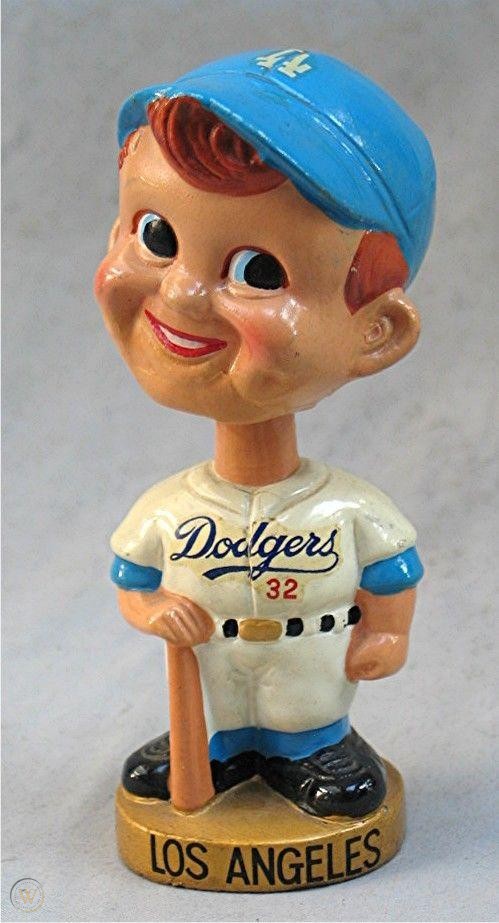
It was truly the wild west and not everything they tried worked, but they were game for trying almost anything. The story goes that In 1958 the Dodgers’ first year in the Coliseum, individual fans rose in the stands to play a six-note bugle call that had elicited the cry of “Charge!” at University of Southern California football games for years. The Dodgers crowd responded. So Goodman, with Warsaw’s help, found a manufacturer to make foot-long brass trumpets. They sold for $1 and came with instructions for playing those six notes. But the bugles didn’t work out - they shattered when dropped by kids, and the line was dropped.
After the 1956 season, the Dodgers owner, Walter O'Malley, took the then-Brooklyn Dodgers to Japan on a goodwill friendship tour that saw the Dodgers play a 20-game exhibition schedule from October 19 to November 16. I believe that David Warsaw, who was very familiar with Japan because he had been manufacturing products there since 1936, likely joined the Dodgers for at least some portion of that 1956 trip and that it was no coincidence that Goodman had introduced the Japanese made bobble head doll to minor league baseball parks earlier in 1956. For more on Danny Goodman, please read this great article by Andy McCue.


Turn the hands of time ahead a few years, and Pete Rozelle is now the commissioner of the NFL. In 1963, under his leadership, the NFL was the first professional league to develop a business unit – NFL Properties - devoted to licensing each and every team name and logo and share the royalties equally among all the teams. This was a huge development and a master piece of negotiating on Rozelle’s part – the principle of sharing licensing royalties equally among all the teams is a concept that must have been very foreign to the entrepreneurial team owners and as mentioned earlier, something that European soccer clubs have never accepted. But back to Rozelle establishing a licensing program for the NFL – guess who the first NFL licensee was? None other than Sports Specialties.
 |
| NFL Licensed LA Rams Bobblehead |
Over the next 10-20 years, Sports Specialties was arguably the leading licensee of the NFL and MLB (MLB Properties began in 1966 and as you could imagine, Sports Specialties was one of the first official MLB licensees). As David Warsaw said of that period of time, “Eventually, we made everything you saw in ballparks (and stadiums) except food and jewelry." This is why Stern and Rozelle called Warsaw the father of the licensed sports product business.
Warsaw knew the value of licensing agreements and expanded Sports Specialties product range swiftly. By the 1960s, the company had grown considerably and become not only the first official licensee of the NFL and a leading licensee of MLB, but also the official locker-room supplier for the NBA finals, The Super Bowl and the NCAA Final Four. By the 1980’s, licensed sportswear had begun to grab the hearts, minds and wallets of American sports fans in a major way. Until then, there had never been a large market or a whole lot of interest invested in licensed apparel at least in part because some felt that allowing the public to wear team branded merchandise would lessen the brand. The story is told of George Weiss, GM of the NY Yankees from 1948 to 1960, who said "Do you think I want every kid in this city walking around with a Yankees cap?" But thanks to a combination of events, the most important of which I would argue was the explosion of television coverage of North American pro sports, the licensed sportswear market took off exponentially in the 80’s and early 90s.
What is interesting when you compare things to today, is that from the outset as an NFL and MLB licensee, Sports Specialties was allowed to be both a hardgoods licensee and a softgoods licensee, something that is almost unheard of today. So while they were making hardgoods products like bobbleheads and drinkware and other trinkets, by the mid-late 1960’s Sports Specialties had also become the world's leading licensed sports headwear company.
From the mid 1960’s to the mid 1980’s, Sports Specialties transitioned from being both a hardgoods and soft goods licensee to a total soft goods focus - a transition I don’t think would be possible today. And it’s interesting to me that they had the choice of which to focus on, and they correctly (from a revenue point of view) backed the right horse – soft goods. In fact, some time in the early 1980’s David Warsaw sold the novelties part of his business to focus on ballcaps.


In 1984 Sports Specialties became an official licensee for MLB ballcaps with their signature wool cap called “The Pro" and at the same time introduced their now infamous NFL Pro Line “Script” snapback hats (see this great article by the ever amazing Uniwatch blog). They also had NHL and NBA headwear licenses at this time.
 |
| NFL Pro Line Script ballcap |


The Pro caps were mostly manufactured by the Young An Hat Company in Korea and are recognizable by their thick wool, flat embroidery, and short, square visors (some were also made in the USA at a plant in Winslow, AZ). In 1986 Sports Specialties and New Era were granted co-exclusive licensing for MLB caps (under the "Diamond Collection" label), making them the only two makers of on-field caps. More than half the MLB teams used Sports Specialties caps from the mid 1980’s through 1993 (Baltimore, Boston, Chicago Cubs, Cincinnati, Colorado, Detroit, Florida, Houston, Milwaukee, Minnesota, NY Mets, Oakland, Philadelphia, San Diego, San Francisco, St. Louis, Texas). But Sports Specialties never gained much of a following with MLB teams, and in 1994 New Era won an exclusive license to supply on-field caps to all MLB teams. Sports Specialties continued making MLB caps for several years for retail only, which were now 80% acrylic and without an MLB label inside or the batterman logo on the back.
David Warsaw’s two sons, James and Robert, became involved in the business in the early 70’s. Younger brother, Robert, served as Chairman and was in charge of production and distribution while older brother Jim was president and headed up the company's marketing efforts.
The Warsaws sold their firm to MacGregor Sporting Goods in 1986, but after an acrimonious year with MacGregor, in 1987 they engineered the sale of their division to New York investment firm Oppenheimer-Palmieri Fund L.P. The family retained a minority interest in the company. In 1992, Oppenheimer sold the business to Nike for $78 million.
 |
| Sports Specialties 1992 NHL Product Line |
In the period of time from 1987 to 1992, after Sports Specialties was acquired by Oppenheimer but before it had been sold to Nike, the younger Warsaws ran the company with input from their father. In September 1990, Jim Warsaw did a great interview with the LA Times that provides some historical insights, and while a bit lengthy, I wanted to reprint most of that interview.
Sports Specialties Corp. is going through some pretty heady times as it rides the wave of international demand for American sports and sports products. The Irvine company makes the popular Pro brand cap, authentic headgear that the pros wear. It holds licenses from all the major professional sports leagues and college associations, as well as the International Baseball Assn., which covers about 80 nations. The international link has become a major factor in the private firm's continued growth. Four years ago, the company was filling occasional orders from fans in foreign countries. Today it gets more than 10% of its $40 million in annual revenue from overseas sales. By the time the 1992 Olympic Games roll around, the firm expects to be generating 20% of its revenue in foreign trade.
Sports Specialties, founded in 1928 in Chicago by David Warsaw, introduced the nation to sports merchandising. Warsaw hawked a variety of sports souvenirs in Wrigley Field and Soldier Field. In the 1950s and '60s, the firm sold the popular spring-neck bobble-head dolls out of the Los Angeles Rams novelty shop.
As his two sons, James and Robert, started to take roles in the company, Warsaw sold the novelties operations to concentrate on producing high-end caps. The firm now makes caps in three foreign plants and in Winslow, Ariz., using wool, corduroy, cotton twill, polypropylene and, catering to the fashion set, leather.
The Warsaws sold their firm to MacGregor Sporting Goods in 1986, but after an acrimonious year with the New Jersey company, they engineered the sale of their division to a New York investment firm. The family retained a minority interest in the unit.
As chairman, Robert A. Warsaw, 41, oversees production and distribution.
James H. Warsaw, the company's 42-year-old president, heads up the company's marketing efforts. He recently spoke with Times staff writer James S. Granelli about the company's effort to cash in on foreign demand for Pro caps.
Q. How necessary are international sales to your business?
A. I think it's extremely important for our company's presence to grow and flourish overseas. We are committed to being the leader in authentic, high-quality caps in world professional sports as we are in American professional sports.
Q. How did you get interested in the overseas market?
A. It goes back many years. When the O'Malleys (team owners) took the Dodgers in the late '50s and early '60s to Japan every year, my father would make that trip too. And later Sandy Koufax and Joe DiMaggio went down to Mexico on separate trips with American baseball organizations and became American heroes. They were baseball heroes overseas. So that was kind of inbred in me growing up 25 to 30 years ago. However, I saw it as a definite asset from a business perspective at the American Bowl three years ago, when the Denver Broncos and the Los Angeles Rams played in London. More than 85,000 people in Wembley Stadium watched, and less than maybe 10% of the people attending fully understood what was going on. But they were totally involved in the hoopla of the bands, the cheerleaders and the big blokes, as they called them, hitting each other through the line. And finally, of course, I saw the merchandise being sold successfully, and the people getting enjoyment out of that. I felt that that was definitely a market to pursue.
Q. Did you start in England?
A. Yes. Then later the NFL had games in Japan, and last year the (San Francisco) 49ers and the Rams played an exciting game in the Tokyo Dome. And this year we're marketing our NFL goods in Japan.
Q. Long before you went to London, though, you had been filling small, personal orders for people around the world. Didn't that indicate that there was a broader market for you?
A. Well, what has happened is that the satellite generation and the global economy have created a worldwide awareness of American sports. And this is not just on the field; it's off the field. It's the mannerisms; it's the fashion; it's the look; it's the lifestyle that is America. That creates an opportunity for this company to be successful overseas.
Q. How did you learn about foreign markets?
A. My brother and I got our training from our father, who started importing from Japan in 1936. He brought in the bobble-head dolls, the baseball gloves, the bats, the balls, the T-shirts, the whole line of American sports souvenir products and merchandise that this company pioneered. When we graduated college, he said it was time for his Ph.D. program, and that was to live overseas--my brother in Taiwan and myself in Hong Kong-- for several years in the early 1970s. What we learned about developing foreign markets there has been very, very instrumental in our initial success in marketing overseas in the last few years.
Q. But foreign trade wasn't the intent of this "doctorate" program, was it?
A. No. It was learning about the factories, the people, the business. The other thing that we learned then, that we feel is paramount now in our relations with other countries, is that their habits, their traditions, their mores, their customs are very important to respect and honor in our business relationships.
Q. Once you decided to put that experience to work in foreign trade three years ago, what steps did you take to develop sales overseas?
A. Well, we developed it through our relationships with the (professional) leagues, simultaneously with the inquiries we were getting by fax, by telephone, by mail from overseas. I'd say we now average between 50 and 100 faxes a week, inquiries from all over the world. We've developed a very exciting market in Australia, partially because of TV exposure of the major special events in the United States, like (the) Super Bowl and World Series. This fuels excitement, enthusiasm, American lifestyle, American sports overseas. That is what we are getting in these faxes.
Q. In developing your international strategy, did you hire consultants or anyone else to help or did you believe you had enough experience to sell overseas?
A. Basically, the international experience has to be well coordinated with the leagues and the leagues' consultants and the leagues' experience. Their people sort of paved the way for a smooth overseas distribution of licensed products, including Sports Specialties caps. For example, we made a decision that we were not going to take our own people and our own warehouses and tell the people in Germany, Sweden, Switzerland, Italy or Spain how to do business with their own people. However, with the demand that's been created with our advertising, and our point of purchase materials, we offered sales technique assistance that has been very beneficial. So as a team, we feel we could generate maximum results in local foreign markets.
Q. Did you have to tailor either your caps or your marketing strategy for any particular markets or for overseas in general?
A. Well, it's interesting. Last year, for example, we met with representatives in baseball from Bulgaria, Czechoslovakia, Yugoslavia and Romania. Dealing with their needs first had some political constraints. A year later, those problems have become a lot less severe with the opening up of the Eastern Bloc countries.
Q. So you had structural adjustments to make, but the caps--and the American sports culture that fosters their appeal--sell themselves.
A. Yes. One of the very important things that appeal to international interest and Sport Specialties is the International Baseball Assn.'s success in developing Olympic medal sport status for baseball, starting with the Barcelona games in 1992. That has fueled interest all over the world. Nigeria and Ethiopia started teams recently. Romania, Bulgaria and other Soviet bloc nations that never had teams before are being helped by the Olympic movement in baseball.
Q. Are you supplying caps to IBA teams?
A. We've developed a sponsorship with the IBA about two years ago, and we have developed national team caps for 35 to 40 countries right now. We'll be in the process next year of developing the balance of IBA's membership, which is almost 80 countries. The other interesting thing to look at in this whole marketing segment is the cultural exchanges of professional sports teams and athletes. You have Yugoslavs like Vlade Divac, for instance, playing with the Lakers. Playing for professional sports teams here provides a tremendous impetus and demand in their native countries for U.S.-related sports products, including our caps, and team-identified merchandise.
Q. What caps are selling overseas?
A. The new polypropylene hats that we introduced a year ago are more accepted in Europe than they are in the United States. For example, the Pro workout polypropylene cap has very unique properties that help to keep you cool when it's hot, warm when it's cold and dry when it's wet. Professional football players loved it last year in training camp because as much as they'd sweat it would dry off quickly. In conveying this to the American consumer, we had a more difficult time than we did overseas. It's been very well accepted overseas, and we don't have to mention the properties of the fabrics and how they work.
Q. What merchandise hasn't worked overseas?
A. We haven't been as successful in Europe with our cotton twills, for example, probably because of the cold winters. We've been more successful in the heavy caps: the corduroys, the wools, the polypropylene. The cotton twill fabric is not as readily accepted as it is here.
Q. Have you found any other differences in marketing Pro caps in foreign countries?
A. This is very interesting. What we found out was that the most important factor was color. We're selling colors. We're in the fashion business, and our overseas marketing is ahead of our domestic marketing in that. It's the fashion element. It's the whole understanding that you don't have to be a fan of this team to wear the cap because this is matching with an outfit.
Q. Have you had to make any major tactical or marketing adjustments?
A. We've been very successful in promoting the authenticity of our caps. But we ran into a problem in some European and Scandinavian countries. Some countries did not want us to use their native tongue. They said this would be great in English and would promote the authenticity of the American sports. So where we had thought we would translate an American ad into a foreign language, we found it would be more effective, because of the cultural message we're trying to convey, if we did it in English, which is often spoken by Europeans anyway.
Q. You also make and sell foreign team and university caps. Have you found anything different in selling those caps?
A. Yes. We make the official team caps for various countries, and we're just beginning to market those overseas. The names of all the teams, except for one, are in English. The only team that wanted its name in the native language is Italy. They wanted 'Italia' on their blue and white caps. I said to the head of the team, 'Aren't Italy's colors different from blue and white?' He said, 'Yeah, but we saw the Dodgers.' They took the blue and white.
Q. How much time and money did you invest before you began to see any returns from overseas sales?
A. Well, ironically, the people were always there prior to a formal structure of our system. And this was because we wanted to have our structure carefully set before we went out and marketed both our products and our name--our brand name and our family name--overseas. So we had the ducks in the pond long before we were swimming.
Q. Wasn't there a financial drain in doing this?
A. No, because the financing was there, and we had monitored the market looking for the right time to enter. And the right timing came in 1987.
Q. Where did you go for financing?
A. We financed from existing cash flow in the company. One of the strengths of this company over the years has been cash flow. And once again, it came to our very good assistance in developing this market.
Q. So you hit a market ripe for your caps.
A. Yes. And there was another timing factor. The leagues themselves became more aware of the demands of the international markets. For example, Major League Baseball just formed a partnership called Major League Baseball International Partners with NBC's London-based affiliate.
As mentioned earlier, the company was sold to Nike in 1993, three years after Jim’s interview. At the time it was reported that they had annual revenues of $70 million. Robert and James remained with Nike for a short period of time, but by 1995 they had parted ways, formally ending the Warsaw’s relationship with Sports Specialties. Then in 1996, founder David Warsaw passed away at 83, prompting NBA Commissioner David Stern and former NFL Commissioner Pete Rozelle to say what they did about the remarkable Warsaw. And by the late 1990’s, Nike/Sports Specialties had been pushed out of the MLB cap market. By that time the name Sports Specialties had largely disappeared into the annals of history.
Thanks for joining me on this look back in time and on the tremendous legacy of David Warsaw.
Scott
=========================
A bit more info:
Jim Warsaw died at 61 in 2009.
Shortly after leaving Nike, younger brother Bob Warsaw founded promotional apparel company Covee in 1995. Covee, still based in Irvine CA, produces custom headwear, apparel and accessories for the promotional sports industry, corporate and private label brands and retail. As their website says "Covee is a new brand rooted in the Warsaw family tradition - creating authentic, innovative designs for headwear, apparel and accessories and delivering them on time with competitive pricing. It’s a business philosophy that’s proven successful for almost a century."
1 Technology Drive, Bldg B, Suite 123
Irvine, CA 92618
Ph: 949-465-8282
E sales@coveellc.com
Some of the sources used in this blog posting:
1. From Sport Marketing, Volume 13, Third Edition by William A. Sutton, Stephen Hardy, Bernard James Mullin, originally published in 1993 and republished/updated numerous times.
2. Sept 1990 LA Times interview with Jim Warsaw
3. LA Times April 1996 David Warsaw obituary
4. Sports Specialties ball cap history put into perspective with other ballcap manufacturers
5. 1992 Sale of Sports Specialties to Nike - NY Times - June 20, 1992
6. Bobblehead history and Danny Goodman's role
7. A great 2011 ballcap blog posting by Agora Clothing in the UK
7. A great 2011 ballcap blog posting by Agora Clothing in the UK


